Contents

Showing posts with label Dance. Show all posts

Wednesday, January 17, 2007

Tango Festivals

MIAMI 2007
TANGO FANTASY FESTIVAL
The largest and longest tango festival in the world outside of Argentina!


9 Days at Miami Beach's

11th Annual11th Annual

Friday, May 25 through Saturday, June 2, 2007

Miguel Angel Zotto and Romina Levin
Osvaldo Zotto and Lorena Ermocida
Fabian Salas and Carolina del Rivero
Facundo and Kely Posadas
Silvia Grynt and Guillermo Salvat
Dany "El Flaco" Garcia and Silvina Valz
Guillermina Quiroga and Claudio Villagra

star

Once again this year, Tango Fantasy presents TWO Masters of Tango Shows!
(Sunday, May 27 and Saturday, June 2).

Tango Fantasy Festival 2007 will have 10 "Taxi Dancers" imported directly from Argentina to dance with all the ladies at our 9 nightly Milongas and also assist with daily workshops.
This fabulous benefit is for all female registrants.

An authentic "Milonguero" from Buenos Aires will conduct special workshops.
More news and registration form on our flyer. Call us to be added to our mailing list.


Register early for savings. Email Lydia Henson tangofantasy@aol.com or info@TangoFantasy.com
or call (305) 274-2705.

The teaching schedule from last year will show you how it works. The schedule for 2007 will be posted when finalized - but the format will remain the same.


SCHEDULE

  • This year there will be 112 Master classes.
  • Our smallest group class dance floor is 1,800 sq. ft., there will be over 8,000 sq. ft. of dance floor for the classes and Milongas.
  • There will be three class levels running.
  • The duration of all classes is 1 ½ hours.
  • Milongas with guest d.j.'s every night.


PLEASE E-Mail right away tangofantasy@aol.com or info@TangoFantasy.com or call (305) 274-2705.

If you already have the registration form, mail check to:
Lydia Henson 5757 SW 88th Ct. Miami, FL 33173

The Third New Jersey Tango Extravaganza

Carolina Zokalski and Diego Di Falco
Together with
Gregory Lordi and Jean Torsiello
Proudly Present:

The Third New Jersey Tango Extravaganza
March 2nd - 4th 2007
The North Maple Inn, Basking Ridge, N.J.


The Wondrous Weekend Features:

Internationally Acclaimed Instructors and Performers:
Carolina Zokalski and Diego Di Falco
Miriam Larici and Hugo Patyn
Fernanda Ghi and Guillermo Merlo
Sandra Bootz and Gabriel Ortega
(Stars of the Current Forever Tango Production)


* 41 Hrs of classes on Friday, Saturday and Sunday *

More Classes, More Tracks and More Dance Floor!!
*Including: Intermediate I, II, Advanced, Specialty, and Fundamentals

*Friday Mega Masters Class - Taught by All Four Master Couples

* Friday Evening 'Fabulous Forties' Milonga with Special Performances *

* Saturday Evening Dinner Dance with a Spectacular Show *

* Sunday Evening Milonga *

World renown performers, instructors and choreographers Carolina Zokalski and Diego Di Falco have created an extraordinary event which incorporates their Tango experiences performing, teaching and traveling throughout the world.

For information: Call: 908.221.1033 or 201.585.8346
email:info@gardenstatetango.com

Wednesday, November 08, 2006

More Tango in Norwich

Norwich tango

Friday Nights @ Thorpe Hamlet 1st School

7-10.30 pm £4 (£3 concessions)
Includes beginners and improvers lessons 7.30 - 8.30 followed by dancing. No partner or previous experience required just a pair of slippery-soled shoes (leather is ideal) Thorpe Hamlet 1st School
Telegraph Lane East, Norwich, NR1 4AN


Norwich Tango Constitution
Constitution


Email: info@ NorwichTango.com
Information: 07786 796478

2nd ENGLAND TANGO FESTIVAL

England Tango Festival Website


The Festival Programme

3 Dance floors in continuous use for 10 days of tango
3 Levels - Beginners, Intermediate and Advanced
3 Package priced Options

Option 1 12-13 or 19-21 Jan 3 day weekend £380
Option 2 12-21 Jan Full Monty (10 days) £780
Option 3 13-14 or 20-21 Jan 2 day w/e (no accom) £180
Includes as many workshops as you can manage, as much food as you can eat
and refreshments

Group A Advanced
Group B and C Intermediates Higher and Lower
Group D and E Beginners and Improvers

Workshop Programme

15 workshops per day, one and a half hours each from 10.00am to about
5.00pm on 3 floors .
Then in the week, at least two workshops every day, film shows, free dance floors, discussions, private lessons. Ideal for beginners,
intermediate and advanced.
The packages include as many workshops as you want to manage and as much food, as much dance, as many cups of tea- but the
resident masseur/se is extra.

Arrive on the 11th Jan and settle in, grab something to eat and drink then start dancing.

Tango in Devon

Tango Oblivion


"The way I teach Tango focuses on finding your own centre, creating a point of energy within yourself, and connecting from there with another person without losing your own balance. For me, Tango is improvisatory, a place to dance your inner self. I always say: if you can walk, you can learn the Tango. If you feel you have two left feet but you always wanted to try out dancing, here's your chance."

Tango offers a unique place to find out about our presence, about how to communicate clearly without dominating, and about how to follow actively, without losing our own power. These are qualities that we need in our everyday life, especially if our work brings us into close contact with many people. Besides being fun, Tango can provide a 'playground' to sharpen our awareness and to practise our skills of interaction.

My worthy administrator, watching me from the side lines, comments on my teaching style as follows:

Feel the floor

Feel yourself

Feel the music

Feel the contact

Feel your partner

And . . . . . dance, dance, dance


United Free Church Hall (Sunday Practicas, 3rd level classes, various workshops and some special events)
Go up the little old shopping street in the centre of Town. 50 metres below the arch you will find the United Free Church on your left. Go through the white door on the side and reach the Church Hall at the end of a beautiful alleyway. I tell you, it's worth coming to the Practica just to experience the alleyway!

The Mansion (Monday evening classes)
The Mansion is situated in the Centre of Totnes. Just walk up the shopping street and you will find it opposite Lloyds Bank.

The Ariel Centre
The Ariel Centre is the Theatre space connected to KEVIC's, the comprehensive school in Totnes. You will find it on your left as you leave Totnes towards Dartington, just past the orange foot bridge.

The Barrel House (Rough guide to Tango and Dancing)
This is one of Totnes's pubs/restaurants, at the top of town, just above the market place on the right hand side. We will dance upstairs. The Barrel house serves good food, so bring enough money with you!

The Masonic Hall
Find the Market place in the upper part of the town. Facing the back of the Market place, you will see the Masonic Hall. It is an odd looking tall and lonely red brick building by the side of the path that leads to the big car parks.

St Mary's Church Hall
Take a little time to find this one if you haven't been there before! St. Mary's Church is the big red brick Church 100m below the market square on the high street. Just above the church, past the jewellers, is a little alleyway which leads you by the side of the Church. Walking along this alleyway, you will find at some point on your left an even smaller alleyway, which starts off with an iron gate underneath an archway. This will lead you to the Church hall.

The Totnes School of English
This one's easy to find: it's in the Arch with the clock tower, in the middle of the Town!

Birdwood House
Find the market place in Totnes. When you stand facing the market place, with the street in your back, Birdwood house is the first house on your right. the classes are taking place upstairs.

Elsewhere:

South Zeal Village Hall (Henry's Party & 3 days of workshops)
From Totnes, go up the A38 towards Exeter. Take the Bovey Tracey turn-off. Go to Bovey Tracey. Straight across two roundabouts will take you along the outskirts of Bovey Tracey and onto the A382 towards Moretonhampstead. Stay on that road for a good 20 minutes (beautiful!!!), through Moretonhampstead (sharp left turn but stay on the road) an on to Whiddon down. When you come to a little roundabout, follow the signs to South Zeal and Sticklepath. After a few miles, South Zeal is signed on the right hand side of the road. The Village hall is in the very centre of the village. It would be good to park on the car park a few hundred metres away from the Village hall. look out for signs to the car park, it is up a little road to the left.
From Exeter, go westwards on the A30 for about 20 minutes. On the first roundabout, go off and follow the signs to South Zeal.

Train and bus times to South Zeal:
Train London Paddington - Exeter (you and also take trains in the direction of Plymouth or Penzance) on Friday afternoons: (12.05-14.08), (12.18-14.56), (13.05-15.18), (15.05-17.30), (16.05-18.16), (16.35-19.15), (17.03-19.23), (17.33-20.11) - please double check nearer the time!
Tickets are cheaper if you buy in advance and ask for return tickets if you plan to return by train too. they are even cheaper if you travel already on the Thursday :-)
Click here for the train web site.
Bus from Exeter to South Zeal - (direction of Okehampton): 14.25, 15.25, 16.25, 16.55, 17.25, 17.55, 18.25, 19.40, 20.40, 21.40

Tango in Atlanta


Fabian Salas & Carolina del Rivero in Atlanta Nov 16-20, 2006

Thursday, Nov 16

8:15pm - 9:30pm Volcadas (Int/Adv)

9:30 pm - 12:00am Practica

Friday, Nov 17

8:15pm - 9:30pm Vals (Inter/Adv)

9:30 pm - 1:00am Evening Milonga - DJ Manuel

Saturday, Nov 18

1:00pm - 2:15pm Ganchos (Int)

2:30pm - 3:45pm Sacadas (Int/Adv)

4:15 - 5:30pm Colgadas (Adv)

9:30pm - 2:00am Evening Milonga - DJ Manuel

INCLUDES PERFORMANCE BY FABIAN & CAROLINA!

Sunday, Nov 19

1:00pm - 2:15pm Boleos (Int)

2:30pm - 3:45pm Fabian & Carolina's Favorites (Int/Adv)

4:15 - 5:30pm Soltadas, Tomadas & Pasadas (Adv)

All events at the Atlanta Opera Rehearsal Hall 728 W. Peachtree St. Atlanta 30308

$25 for each workshop
$10 for each practica/milonga

Special Packages
$65 for 3 Workshops
Thurs Volcada Workshop includes Practica
Fri Vals Workshop includes Friday Evening Milonga
$25 Milonga Pass (2 milongas + 1 Practica)
$175 for evertything (8 workshops, 2 milongas + 1 Practica)

For online registration www.tango-rio.com/Reg-Fabian06/

or make checks payable to Tango Rio and mail to:
Ronda Patino
490 Marietta St. #102
Atlanta, GA 30313

Tango York

Guppy's Club
17 Nunnery Lane
York
YO23 1AB
(see directions, etc.)

Telephone: 01904 622879

Dance Tango Argentino 8.30pm until 11.00pm every Friday

FUTURE DATES:
10th November 2006
17th November 2006
24th November 2006
1st December 2006
8th December 2006
15th December 2006
22nd December 2006
29th December 2006
5th January 2007
12th January 2007
19th January 2007
26th January 2007
2nd February 2007
9th February 2007

There will be no formal tuition on these evenings, practica is generally regarded as an assisted session, when more experienced dancers may help out beginners or improvers if asked to do so. In practice everyone has something to contribute and to learn


Argentine Tango Dance Terms


Arrastre Dragging


Barrida A sweep


Boleo A quick flick of the lower leg


Cabeceo Dance invitation by eye & head movements


Colgadas Hangs


Candombe African origin music/dance


Corte A cut


Cruzada To cross


Enrosque A twist


Gancho Hook


Golpecitos Little toe taps


Golpes Toe taps


Guapo Handsome


Giro A turn


Lapiz Pencil


Milonga A place to dance tango


Milonga Cheerful dance related to the tango


Milonguero Frequent dancer


Molinete Fan


Ocho A figure eight


Parada A stop


Practica Practice session


Sacada A displacement of the leg or foot


Salida Exit or Start


Traspie Triple step


Tanda A set of dance music


Rulo Curl


Valtz Argentine waltz


Volcada Falling step (to tip over)

Argentine Tango dancing in Norwich


tango eXpress

Argentine Tango dance classes and a practice session.


Wednesday 29 Nov

Choreography Workshop
@ Keir Hardie Hall
7.30 - 9.00 pm
£5

Wednesdays

@ Keir Hardie Hall
or Tootsies

Beginners 7.00
Improvers 7.30
Practica 8.00
Intermediates 8.30

1 class & practica £3
2 classes & practica £4

8 Nov Keir Hardie
15 Nov Tootsies
22 Nov Keir Hardie

Three tango clubs in Cambridge


Every Tuesday
8:30pm to 11.30pm
£3 (£2 concessions)

Centre at St Pauls
Open dance, drinks available, or bring your own.
Large wooden dance floor and a nice friendly atmosphere
3rd January 2006 - 19th December 2006
9th January 2007 - 18th December 2007
Dropin classes from 7:30 - 8:30pm:

Intermediate


Every 2nd and 4th Saturday of the month
9:00pm to midnight
£4 (£3 concessions)

Unitarian Church Hall
Great music, fun dancing, soft lights and good company.

Beginners/improvers class and practice
7:30 - 9:00pm

Saturday Dates
25th Nov only (cos of our Cambridge tango festival)
9th Dec - Christmas Party.
Jan 13th and 27th
Feb 10th and 24th


Tango Practice

Every Friday

Dates

Every Friday from 1st September until the 8th December 2006

EXCEPT Friday 10th November when the Practice is cancelled due to the Tango Festival

Times

Pre-Practice Class starts at 7.30pm

This class is not suitable for absolute beginners. If you have never danced tango before, please come to the Tuesday or Saturday drop-in classes to get your first taste of the dance. Practice: 8:00-10:00 pm

Venue

Ross Street Community Centre

Price

Class and Practice £5/£4
Practice only £3/£2

Contact

Annette
Email: toberbeg @ yahoo (adding this bit: ".co.uk" to the end)
Telephone: 364691

Sunday, October 22, 2006

Chapter 3: Cat on a hot dance floor

A Tutorial About Argentine Tango Dancing

TANGO, OUR DANCE

One of the often used analogies to describe the motion of Tango dancers on the floor is that they walk like a feline. The subtle, catlike, cunning displacement of good Tango dancers speaks plenty of connection, sensuality and finesse.

How, then, can we learn to move like a cat, while watching where we are going, taking care of our partner and listening to the music? Did somebody hiss, “technique”? Absolutely! As with any other discipline, learning to dance the Argentine Tango requires technique in order to develop a dancing personality of your own. Otherwise, the temptation to imitate others is the curse of the lazy dancer. Think about a handful of world class Tango dancers, Pablo Veron, Miguel Angel Zotto, Osvaldo Zotto, Pablo Pugliese, Eduardo Arquimbau, Carlos Copello, you name them. They all are superb dancers, they all can teach and they all dance completely different from each other. The same thing applies to the ladies: Milena Plebs, Alicia Monti, Miriam Larici, Marcela Duran, Cecilia Saia, Lorena Ermocida, Esther Pugliese, and the list goes on. Spectacular dancers, yet, each one dances with a unique personality and style.

The common denominator is technique. Technique is acquired with knowledge and honed with practice. Of course, we have not overlooked talent, but that is what makes those and other stars who they are.

The beginning of the dance

Many of the unique traits of Argentine Tango dancing are the result of protocols, rituals and habits developed along the line of time since the first man raised his left arm and embraced a woman with his right. The salida, the beginning of the dance, is part of the ritual of Tango dancing.

Traditionally the “best” women dancers were seated in the front row around the dance floor. This still takes place in many popular dance halls in Buenos Aires. The men would either be in the center of the dance floor or near the bar from where they could see and be seen by the ladies. The object was to make eye contact and imperceptibly ask a lady to dance with a nod of the head. A lady wishing to accept the invitation would indicate so with a minimal motion of her eyes, her lips, or her head. At this point the man would walk towards the lady without losing eye contact, a sort of reassurance that the eyes he was looking at, were looking back at him and not for some other guy coming from behind him.

After accepting the invitation to dance, the lady would wait until the man got closer to her table and then she would get up and step forward with her back to the table and facing the dance floor. The man would stand in front of her facing away from the center of the dance floor. The accepted protocol expected that the couple would not disturb the dancing of others already dancing, so their first step would have to be in the line of dance, i.e., the man’s side step to his left, the lady’s side step to the right.

Then, a left turn of the man's upper body would line them up to join la ronda and they would proceed to complete what has became known as the salida, the beginning of the dance, which commonly ends with the cross, but it doesn't have to necessarily happen that way.

Do you have to start with a step to the side? No. Can you start with a back step? Yes. In which of the two situations can you see the space in front of you? Which of the two situations would minimize the possibility of stepping on somebody dancing behind you? Rather than engaging in a philosophical debate over which is the best way to start moving, we suggest that you use common sense. There are some crowded situations where you are almost forced to move in one and only one direction. You may back out of your driveway, but would you back out on a freeway?

The Salida

At the beginning of the dance, both dancers are facing each other and their legs are closed, that is their feet are together. The first step keeps the dancers facing each other but their legs are open. Throughout the dance both dancers will be repeating the same movement, opening their legs, then closing them. This is a simplistic concept yet it is the way we dance. There will be times when one dancer opens the legs while the other keeps them closed or viceversa. Tango dancing requires a mark from the man, a motion by the lady and a subsequent motion by the man. Sort of the way a cat displaces his body by moving one leg at a time. The combined bodies of the dancers and their four legs move in a similar fashion.

Every time we step we open our legs. Every time we bring our feet together before the next step we close our legs. So, stepping to the side is the same as opening the legs wide. Stepping forward or backwards is the same as opening the legs deep.

A very commonly used sequence for a salida consists of a side step, two steps in the direction that the man is facing, and a return to the closed legs position. When the dancers are in the closed legs position, their bodies are fully facing each other. Their feet can be together or crossed.

A typical salida then, consists of:

(1) A side step to the right of the lady. The man's body shifts slightly to the left in order to walk outside the lady.

(2) Two steps, forward for the man and backwards for the woman.

(3) A forward step for the man and a back step for the woman who crosses her left leg over her right to come back into a full frontal alignment in front of the man. This position is similar to the body position the dancers had at the beginning of the salida but now her feet are crossed.

Although the crossing of the lady's leg is a very common occurrence in Argentine Tango, the man has the responsibility to mark such a movement. In fact, every single step of the Tango is marked, and this is a very important subject that we will address next month.

Copyright (c) Planet Tango 1998-2000 All Rights Reserved

Chapter 2: The missing video

A Tutorial About Argentine Tango Dancing

TANGO, OUR DANCE

One of the main resources for Tango dancers is the large number of videos available from various sources. Given enough time and patience, most people could eventually copy and replicate some of the breathtaking moves we see in those videos. However, the majority of reputable experts, some of which make a good living dancing for the cameras, will tell you that nobody has ever learned to dance Tango from a video. A video should be a tool similar to the notebook or handbook we used at school, its purpose being to refresh in our minds concepts learned in class, to observe the correct demonstration of an exercise or a sequence of steps and to be a reference source for consultation.

Videos used to watch other people dance are very popular and people insist on buying them with the hope that the magic annointment will come to them by some sort of esoteric transfer from the screen to their bodies. The one and only video we all can certainly use is missing most of the time from our videotheque. It is the video where we see ourselves dance. Reality check they call it, because as we spend a lot of time watching and attempting to imitate visually, we fail to see ourselves and therefore we can’t firgure out why some things are just so difficult to accomplish. Or even worse, we dance our way to the milongas with the wrong opinion about ourselves.

One of the end results is the large number of men who blame their partners for their obvious lack of balance and the inability to execute the way the video demonstrated.

The Posture

At the opening session of the last Stanford Tango Week, young master Pablo Pugliese began his five days of classes by saying “the Tango begins with the posture and it ends in the legs.” Then he proceeded to enumerate several principles which we have heard from various masters as well.

Each dancer must find his and her axis and each must be capable to move without throwing the other out of balance. Simple, yet hard to implement.

There is a visual illusion that makes us believe that the execution of figures and patterns are always done with the body weight on the opposite leg than it actually takes place. Unless we understand the dynamics of the embrace, and how torso, arms and shoulder interact, we run the risk of imitating what we see in the videos placing our body weights on the wrong side of the figure.

The Dynamics of the Embrace

The Argentine Tango dance requires that men and women embrace and move around in unison.

The embrace symbolizes the union of two partners determined to care for each other while enjoying the moment, the music, the floor, the surrounding dancers and each other’s company. The contact makes for pleasant sensations but most important, it provides the means for the transmission of signals that are needed for safe navigation on the dance floor and smooth execution of the dance.

To begin with, both dancers start by standing in front of each other about a foot apart. As they ready to assume the embrace, their body weight gets transferred to the metatarsus area of the foot, commonly known as the ball of the foot or the base of the toes. This produces a natural lean so the upper bodies can come into contact at the chest area.

The right arm of the man is locked at the shoulder as he surrounds the woman’s back by placing his right hand with closed fingers on her left shoulder blade. The woman rests the upper part of her left arm on the upper part of the man’s right arm so she can feel the mark produced by the moving action of his right arm and shoulder. Her left hand should rest softly on the man’s shoulder but it should not exert any kind on pressure or be used for balance or leverage because this will inhibit his freedom of movement and it could contribute to throw him out of balance.

The final link to complete the embrace is the man’s left arm which extends straight out from his shoulder with the elbow bent at about a ninety degree angle. His hand opens in such a way that the woman can make palm to palm contact. His fingers close gently to hold her right hand in place. Both man and woman’s shoulders should be locked so there is no separate motion from the body and the arms.

If the embrace is approached in this fashion, any subtle motion of the man’s upper body will be felt very clearly by the woman, and her upper body will move accordingly. Since feet follow the body, a dynamic interaction of the upper bodies result in a visually pleasant and smooth displacement of the dancing couple.

During the dance, the woman always walks forward or backwards on a straight line, meaning that her leading leg should always move in the direction her body is facing. It follows that to turn, the body must change direction first (using the pivot or swivel of the supporting leg) before the leg moves in a straight line in the new direction.

The man walks with the woman always in front of him, whether he moves to her right or to her left. This is very important to understand. The woman must walk in a straight line. The man can then walk straight in front of her, to her right or to her left.

Having said that, walking for both men and women means adopting a posture that will be both comfortable and elegant. Because of the natural lean adopted at the beginning of the dance, the man will always move with his upper body first followed by his legs attempting always to keep his body weight in the middle not favoring either leg. This concept is important as many already know one the most basics figures of the Tango: the parada followed by the sandwich.

Deficient teaching techniques ask the dancers to “sit” on the support leg making it impossible for that leg to respond on cue. Here is where learning by watching, as popular as it is, is misleading. Argentine Tango is a dance of fluidity and continuity. A man can stop the woman (parada), sandwich her foot, and immediately mark a boleo. The woman cannot respond if her support leg is nailed to the ground with her entire body weight on it. Had she been in the middle, she could boleo and continue dancing without breaking the continuity and progression of the dance.

So posture is important and leads to good balance. The lack thereof is the main reason why we have so many problems replicating what we see on video or putting into practice the mass of knowledge some have accumulated over the years.

Dancing into the embrace

When the woman is properly embraced by the man, the contact that she feels enables her to dance or move "into" the man’s right arm when taking a back step. The woman should attempt to keep contact with the man’s arm while walking back, and especially on the back step of the giro where it is necessary to generate a centrifugal force. It is very important that the man also keeps contact and a connection that can be clearly felt by the woman. When the woman is turning to her right she dances into the direction of her own arm. As the man is turning, he opens his left shoulder a bit, making the space for her to dance into.

Chapter 1: Stand up straight, embrace your partner and walk...

A Tutorial About Argentine Tango Dancing

TANGO, OUR DANCE

In the land of the do-it-yourself and the cult of self-reliance, those of us who decided to learn to dance the Argentine Tango are constantly lectured on the "unstructured and improvisational aspects of this urban dance," and then we are immediately bombarded with an endless array of steps, figures and Spango, a list of Tango names that are supposed to help the English speaking students memorize steps and patterns better. Adding to the mystification of the "unstructured and improvisational dance," are the myriad of traveling “teachers” who carry suitcases full of steps, judgments and ego. At the local level, there are a few methods and systems in circulation that contribute to the bedlam that most “beginners”, “intermediates” and “advanced” level dancers face on a daily basis.

When Humphrey Bogart asked Lauren Bacall how does one whistle, she responded, "put your lips together and blow..." Had he asked her how do you dance the Tango, she might have said, "stand up straight, embrace your partner and walk..."

Yet, after almost ten years since the Argentine Tango fever caught this nation by storm, the general proficiency and the overall quality of the social dance leaves a lot to be desired. Everybody is a performer at heart and the local milonga is the stage to make the dream come true.

Americans are an independent lot, quickly given to instant gratification with a penchant for fixing things that are not broken. As a result of that, the important aspects of systematic learning and the hard work that goes along with that, are easily overlooked and in the few cases where a syllabus or courses have been developed, the tendency has been to catalog a lengthy list of steps and figures which then are used to pigeonhole people according to their capacity to memorize and repeat the steps and figures using a ranking system similar to the ones used by the American and International Ballroom community.

If we accept the fact that the Argentine Tango is an urban social dance that has been in existence for over 100 years, and if we acknowledge the fact that throughout several generations of dancers the core concepts and elements of the dance have only changed as society mores have allowed more freedom of interaction between men and women at the social level, then we may open our minds to a series of concepts, vocabulary and structural forms, that in many different ways, we have learned at one time or another from some of the most talented and gifted dancers and teachers from Argentina.

Putting aside the silly jealousy, envy and down right competitiveness among the masters and the journeymen that follow them, (traits that, if used with caution, you’ll see soon are a necessary ingredient for the attitude required to absorb the Tango in your organism) we are able to rescue fundamental concepts that compiled in a didactic context, may form the basis for a "dancer's manual" of sorts. To that extent, in instances where specific concepts or ideas identify a particular individual we will give the appropriate credit.

The basic structure of the Argentine Tango dance

At the very core of the dance structure, we may define and identify four distinctive set of movements: the Salida, the Caminata, the Giro and the Cierre. Each one will have variations, substructures and exceptions but as we pick apart each one of these elements we will discover what Mingo Pugliese calls "the embodiment of the Tango". That is, out of a finite number of recognizable body positions for the couple, it is possible to improvise a countless number of patterns, steps and figures.

The Roles Dancers Play

During the learning process, both men and women must understand that their responsibilities on the dance floor are quite different. Firstly each one must assume control over their own balance, which translates to finding the correct axis in order to develop the most comfortable posture. Second, both the man and the woman must learn and understand the concept of marking (La marca). This concept is unique to the exhilarating experience of improvisation on the dance floor and unfortunately for many confused dancers in this country, is commonly replaced with the ballroom concepts of leading and following. The confusion has been aggravated by some Argentino teachers who don’t bother with pinpointing the radical difference between marking and leading and following because of expediency, selfishness or ignorance of the conceptual language differences.

A Thesaurus search of the verb "to lead" will produce the following partial list of alternatives: to guide, to usher, to steer, to drive, to direct, to conduct, to escort, to precede, to go before...

We ask the men, regardless of experience, when was the last time you “led”, "drove", "ushered", "went before" your lady partner on the dance floor? According to Rodolfo Dinzel and others who corroborate this concept, the woman always moves first and the man follows right behind (the notable exceptions are the not-so-gentle-men who charge ahead with their feet, dragging the women like a sack of potatoes. They are actually “leading” the lady to believe that they care little for their partners).

The Three Steps of Tango

One of the understated facts of dancing Argentine Tango is the availability of four feet and four cardinal directions where the couple can move. Simply put, there are only three steps in Tango: the Side step, the Forward step and the Back step. The direction is relative to the orientation of the upper body.

Step Aside

A side step is typically shoulder wide and in the direction of either shoulder. In other words, it is a lateral movement that begins with the leading foot extending right or left, followed by a body weight change to that foot and ending with the unloaded foot coming together with or without another change of weight (this will be dictated by the next movement).

Being forward

A forward step requires similar mechanics only that the leading foot advances in the direction where the upper body is pointing. Once that the leading foot’s metatarsus has found the ground, the body weight transfer begins with a slight flexing of the leading foot in order to “pull’ the body weight to its axis. This avoids the “bouncing effect” that occurs when the body is “pushed” by the trailing leg. Once the weight transfer has been completed, the heel of the trailing foot is off the ground and the trailing leg is relatively elongated. Then, and only then, the forward step is completed by letting the trailing foot “fall” next to the support foot. At this point both knees are together and slightly flexed ready to continue.

Know When to Back up

A back step is executed in the reverse order. First the leading foot moves back in the direction where the back of the upper body is facing until it finds the floor with its metatarsus. Then, as the heel touches the floor, the leading leg “pulls” the body for the weight transfer at which point the trailing foot “falls” next to the other ready for the next movement.

A Position of Strength

The position where one leg is slightly flexed with the foot completely on the ground and the other leg is elongated with the heel off the ground is perhaps the one most likely to be in use most of the time while dancing. Should somebody enter the room and take a still photograph of that position, it would be impossible to guess whether the dancer is in the process of stepping forward, stepping backwards, or in the middle of a left or right hand turn.

With these three steps a couple could dance in straight lines or in a box, going forward, sideways, backwards, sideways, etc., etc.

In order to turn one more element is necessary: the swivel or pivot, which is a rotation of the upper body along the vertical axis of the supporting leg and executed by flexing the knee, lifting the heel of the ground and spinning on the ball of the foot.

A sequence consisting of a forward step, a pivot on the leading foot followed by another forward step is the most popular Tango figure universally known as the Forward Ocho.

Likewise, a sequence consisting of a back step, a swivel on the supporting leg with both feet together followed by another back step is commonly known as a Back Ocho.

Finally, we'd like to quote Pablo Pugliese: "the Tango begins with the posture and finishes in the legs". There is an anatomical and a psychological reason for paying attention to posture. From an anatomical point of view, finding a comfortable embrace helps the enjoyment of the dance.

The psychological aspect involves a positive winning attitude. The dancers must believe they are the best they can be.

Copyright (c) Planet Tango 1998-2000 All Rights Reserved


A Tutorial About Argentine Tango Dancing

TANGO, OUR DANCE
This is a series of articles published periodically in El Firulete, The Argentine Tango Magazine by Alberto Paz and Valorie Hart. The information is based on their own experience, first as students of the dance and second as teachers of Argentine Tango around the United States. Copyright (c) 1998-2006 Planet Tango.

Chapter 1
Stand up straight, embrace your partner and walk...
Chapter 15
The Salida Cruzada
Chapter 2
The missing video
Chapter 16
Body language
Chapter 3
Cat on a hot dance floor
Chapter 17
Raising the bar
Chapter 4
Mark me, she said
Chapter 18
Putting the Tango on a solid base
Chapter 5
What Tango shall we dance?
Chapter 19
Dancing on a crowded floor
Chapter 6
Once upon a Tango
Chapter 20
All Roads Lead to Tango
Chapter 7
Glancing is not stalking
Chapter 21
All About Eva
Chapter 8
Dancing with freedom
Chapter 22
Riders of the man's mark
Chapter 9
Consensual Tango dancing
Chapter 23
A Giro state of mind
Chapter 10
Fear of learning
Chapter 24
Picking the lock (step)
Chapter 11
Myths and Misconceptions
Chapter 25
The Great Equalizer
Chapter 12
Sacadas are body displacements
Chapter 26
All Aboard!
Chapter 13
The thorns make my lips bleed
Chapter 27
It's what counts
Chapter 14
The Media Vuelta
Chapter 28
Whatever, whenever

Alberto Paz and Valorie Hart

Like all of the natural 'bailarines de tango' born before 1945, ALBERTO PAZ never studied contact improvisation or modern dance. He grew up as a natural dancer on the streets of Buenos Aires towards the end of the Golden Era of tango. Almost 40 years later ALBERTO PAZ was at the forefront of the renaissance of tango in the United States as an active promoter in California where he managed visiting professional dancers, published El Firulete, the first Argentine tango newsletter, and hosted weekly tango dance parties plus a tango radio program.

Through most of the nineteen nineties, ALBERTO developed long lasting friendships with and benefitted from the guidance and linfluence of Orlando Paiva, Eduardo Arquimbau, Rodolfo Cieri, Carlos Gavito and other great 'bailarines de tango.'

From early 1990 ALBERTO PAZ, was a broadcaster, a historian and a lecturer all over the United States, researching and studying the history of the Tango music and dance. In April 1997 ALBERTO PAZ and his dance partner VALORIE HART, a ballet trained with off-Broadway and summer stock dancing experience with a unique quality for dancing and teaching Argentine Tango, traveled to Buenos Aires to study for a teaching career with renowned master Mingo Pugliese. Upon their return to the US they began touring the country developing a clear and fair methodology for teaching based on the circular structure of the dance. They have been successful in promoting the authentic form of Argentine tango dancing in communities from Anchorage to Dallas, from Honolulu to New York, From Chicago to New Orleans and scores of cities in between.

Since 1997 they have organized an annual tango festival in Reno first and for the last four years in New Orleans. Since May 2002 they have toured various European countries every year receiving praise for their solid understanding of technique and their clear and fair method of delivery.

ALBERTO and VALORIE are well known for successfully developing a logical process to introduce, review and reinforce the essential elements of the structure of the dance, the codes and protocols associated with it, and the rituals that define the personal styling that characterizes a "bailarin de tango."ALBERTO and VALORIE cover basic, intermediate, and advanced technique, floor craft, and music awareness. Their classes are specifically designed to move beyond step collection, overcome short attention span, and correct the bad habits that result from imitation.
They use the Buenos Aires workshop method to optimize the learning process and raise the bar of excellence. ALBERTO and VALORIE provide individual attention matching each participant's level of expertise in a non-judgmental, welcoming, and nurturing network of support and encouragement in order to give everyone plenty of opportunities to advance at their own pace and as far as they wish.

In addition, they publish El Firulete, the Argentine Tango magazine, and are the authors of the inspirational series Tango, Our Dance, which is available on line at Planet Tango's web site.
Mingo Pugliese is a disciple of Carlos Alberto Estevez, better known as Petroleo, widely recognized as one of the innovators of Tango in the dawn of the Golden Era.

Of Giving Thanks...

Alberto Paz
Copyright (c) 2000, Planet Tango. All Rights Reserved
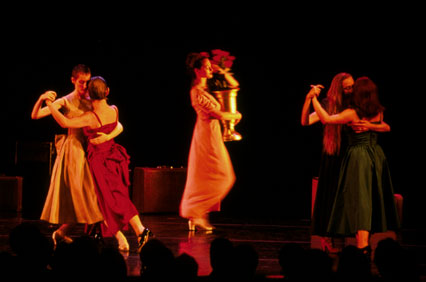

November is turning out to be a banner month for Argentine Tango in this country. Take for example the successful run of Forever Tango on Broadway which has already been extended until March 1998. Or look at the sensational US Tour of Tango x 2 through many cities across the nation crowned by a first class stop in New York City for the US premiere of Una Noche de Tango, a brilliant production that pays homage to the generation of milongueros that kept the Tango alive through years of fierce competition with rock and roll and a frail economy that almost brought Argentina to its knees. This month a constellation of Tango dance stars are shining bright in the USA Tango firmament. Add to that the opening of Sally Potter’s The Tango Lesson starring Pablo Veron, Gustavo Naveira, Fabian Salas, Carlos Copello and Alicia Monti, and the soon to be released documentary Tango: the Obsession by Adam Boucher, a young San Franciscan who spent two and half years capturing the sights and sounds of the men and women of Buenos Aires Tango.

That’s plentiful enough to be thankful for when the turkey comes to the table at dinner on Thanksgiving day.

But, in terms of giving thanks, nothing comes first but our own deepest and heartfelt appreciation to you, who subscribe to our passion and who share our emotions. Month to month, without realizing it, we have crossed the three year mark and we are already one fourth of the way to our fourth anniversary of publication. It all happened because of you, who grew fond of El Firulete, (sometimes you may have gotten jilted by controversy and heated debate, but you recognized our commitment to excellence). In either case, with your support you told us to keep it up, you praised our work many times, you supported our events, and above all you opened your arms to us on every occasion that we had the chance to see each other.

So it is proper and fulfilling to say “thanks” to you.

This is also a good time to thank all of those who have provided a place so we could all dance and to those who played the music while we danced. Thanks to those who danced with us and to those who danced for us and to those for whom we danced.

This issue is very special because it came about across three time zones, from the sunny Golden State to the nippy North East. We are always obsessed with and dedicated to the Tango and everything that and everyone who surrounds it. We believe that the best way to thank you is by dedicating to you this issue loaded with exciting and extremely interesting material that proves that the Argentine Tango is a living experience and that both young and old have something to contribute. Wherever you might be, we wish you a very Happy Thanksgiving and many good Tangos to you and those with whom you share them.

Tuesday, October 17, 2006

video

Monday, October 16, 2006

TANGO MUJER Dance Company

"I wish for: a Tango dance, that tells of memories, that speaks of old times... a Tango, that touches the senses, a Tango, that brings up-to-date, that renews, revolutionary... a Tango with all of the classical forms of movement: bending, stretching, getting up, gliding, jumping, catapulting and turning. Further: dragging, stumbling, moving in space, flying, flapping, wavering back and forth."

- from Petroleo's (Carlos Alberto Estévez) testament
born 1913, milonguero from Buenos Aires

The women of TangoMujer have lived hundreds of nights in Buenos Aires' tango haunts, where the heat of tango beats with such intensity. Their direct experiences of the imperfect but irresistable world of social dance are the wellspring of their feelings for tango. Modern and classical dance, among other movement forms, open and enrich their performances, making their tango wilder, the possibilities limitless.

The typical tango show presents a formulaic drama of seduction and jealousy, too predictable to be convincing. TangoMujer is interested in all the other relationships expressible in the language of tango. Some pieces treat the cliches with irony and humor. Others explore tenderness and longing, the experience of solitude, or the energy of the group.


Sunday, October 15, 2006

Tango for children and youth in Boston

Shahrukh Merchants

Shahruk says...

I discovered the joys (and, I was told, my talent) of teaching Tango to children quite by accident, when Center Stage Dance Academy in Haverhill, Massachusetts was looking for a Tango teacher for their youth master class of kids between 10-18 years. There are special challenges in teaching children (keeping their interest, keeping the class lively and fun and even in picking "cool music") but there are special rewards as well (they learn quickly and are not afraid of trying new things).

If you have a children or youth group who would like to learn Tango, please contact me for more information and to work out the details.

"I really enjoyed working with you and the kids think you are very special. I must tell you that looking at them from the side of the stage really gave me chills. You taught them so well. I truly wish that I could do Tango again with the same kids [but several are graduating this year]. Can you imagine what you could do with them if you had them another year?" - Tina Davis, owner of Center Stage Dance Academy, following their sold-out performance for the academy. See more testimonials ...

Tango for Kids in Los Angeles


Contact Info:
Tel: 310-895-0583
Email: karanrasdan@yahoo

Participating School:
Watts Learning Center
310 West 95th Street
Los Angeles 90003

A community project to teach second- and third-graders the Argentine tango started in September 20th at the Watts Learning Center in South Central Los Angeles.

"I am very eager for the program to start," said Ms. Fisher, the school Principal, "The kids will benefit from having a global perspective on music and dance arts."

"It's great to just bring this art form to kids who otherwise would not be learning this dance" said Tatiana, one of the volunteer dance teachers.

"The idea is to let the kids have fun, a kind of fun very different from what they experience in everyday America," said Karan Rasdan, who is organizing the project.

The benefits are that the kids are more respectful of each other, especially of the opposite sex, that they are comfortable dancing with one another, and that they are sharing the space with other couples."This is the only program of its kind in the United States, that I know of, in which kids are being taught the Argentine tango."

Rasdan, a Los Angeles tanguero, or tango dancer, said the tango program came from his participation in the Self-Expression and Leadership Program offered by Landmark Education in Los Angeles.

"It's an elegant dance," he said, "one that engages the kids' artistic abilities, provides them with yet another outlet for their emotions and self-expression, promotes their fitness and creates a community feeling among them.
"Once they get over their initial shyness, they take to the rules well, and enjoy the experience,"
Karan noted.

"I taught the class once about a year ago, at the request of Sima, a teacher at this school who I know from church, and I'll never forgot the experience, how rewarding it was. So when it came time for a community project, this idea was the finalist - something I'm enjoying doing, and something that involves my passion."
Tango teachers - professionals and amateurs -- will volunteer their time to teach a group of about 20 children per class.

Each teaching couple (a leader and follower required to dance tango) will commit to one day. When they arrive at the school, they consult the tango roster to find out what the students have been studying in the last class.
The teachers then start the students off with the basic steps, and if they can do the steps taught at the previous class well, they will teach them the next steps of the dance, or they will continue practicing the basics, such as lead-follow in a circle.

After the classes, the teachers write down on the roster what they taught so that the next group of teachers can pick up from that point on.

The class will start September 20 at the elementary school located at 95th Street and Broadway, and continue every Monday, from 1:30 p.m. to 2:15 p.m. and 2:20 p.m. to 3:00 p.m.

If you are a Tanguero or a Tanguera, and would like to volunteer once a month, please email karanrasdan@yahoo.com or call him at 310-895-0583.