Contents

Wednesday, November 08, 2006

Passion parade

© Witold Krassowski/Network


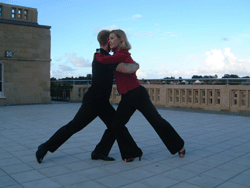
Young Polish professionals have discovered the delights of the Tango. Witold Krassowski photographed at a dance academy which gives lessons in the surprising location of the former Communist militia in Warsaw


Young people in Warsaw are flocking to learn the old time Argentinian tango. Polish yuppies and professionals have enthusiatically welcomed the arrival of an Academy of Tango in their city. Bored with rock and roll, they have grasped at another trendily pastime. Some hope to meet the big love of their life, though they wouldn't care to admit it. The first sessions took place in the former club of the hated communist militia, right next to their notorious headquarters in the Mostowski Palace. Every Wednesday more and more bored young hopefuls congregated in this dark, socialist-realistic environment to experience the double thrill of tango and former danger.Young people in Warsaw are flocking to learn the old time Argentinian tango. Polish yuppies and professionals have enthusiatically welcomed the arrival of an Academy of Tango in their city. Bored with rock and roll, they have grasped at another trendily pastime. Some hope to meet the big love of their life, though they wouldn't care to admit it. The first sessions took place in the former club of the hated communist militia, right next to their notorious headquarters in the Mostowski Palace. Every Wednesday more and more bored young hopefuls congregated in this dark, socialist-realistic environment to experience the double thrill of tango and former danger.


The venue became too crowded and, overwhelmed with success, the Academy had to organise extra sessions every Monday in the former casino of the equally feared secret police. This place lacks the heavy atmosphere of socialist architecture but is much more appropriate for teaching the tango. And the crowds keep coming. The teachers are mainly dance enthusiasts, all young, some expatriates. A few are studying, most have jobs, all give energy and time to sustain their passionate pasttime. They can do incredible things with their legs.


The tango meetings evenings start around 8 p.m. and the atmosphere builds up slowly as more people arrive. First, couples interested in polishing up their tango technique try new steps in the almost empty room. The crowd grows thicker and the bar serves drinks at full speed. Things heat up. Technique goes out the window as emotion and imagination take over. Liaisons take place and some last beyond the dancing. Aspiring newcomers look on from the sidelines, curious at the relaxed but volatile scene before them. At midnight, on the dot, the clientele leave in a cloud of all-pervasive tobacco.

Tango in Atlanta


Fabian Salas & Carolina del Rivero in Atlanta Nov 16-20, 2006

Thursday, Nov 16

8:15pm - 9:30pm Volcadas (Int/Adv)

9:30 pm - 12:00am Practica

Friday, Nov 17

8:15pm - 9:30pm Vals (Inter/Adv)

9:30 pm - 1:00am Evening Milonga - DJ Manuel

Saturday, Nov 18

1:00pm - 2:15pm Ganchos (Int)

2:30pm - 3:45pm Sacadas (Int/Adv)

4:15 - 5:30pm Colgadas (Adv)

9:30pm - 2:00am Evening Milonga - DJ Manuel

INCLUDES PERFORMANCE BY FABIAN & CAROLINA!

Sunday, Nov 19

1:00pm - 2:15pm Boleos (Int)

2:30pm - 3:45pm Fabian & Carolina's Favorites (Int/Adv)

4:15 - 5:30pm Soltadas, Tomadas & Pasadas (Adv)

All events at the Atlanta Opera Rehearsal Hall 728 W. Peachtree St. Atlanta 30308

$25 for each workshop
$10 for each practica/milonga

Special Packages
$65 for 3 Workshops
Thurs Volcada Workshop includes Practica
Fri Vals Workshop includes Friday Evening Milonga
$25 Milonga Pass (2 milongas + 1 Practica)
$175 for evertything (8 workshops, 2 milongas + 1 Practica)

For online registration www.tango-rio.com/Reg-Fabian06/

or make checks payable to Tango Rio and mail to:
Ronda Patino
490 Marietta St. #102
Atlanta, GA 30313

Tango York

Guppy's Club
17 Nunnery Lane
York
YO23 1AB
(see directions, etc.)

Telephone: 01904 622879

Dance Tango Argentino 8.30pm until 11.00pm every Friday

FUTURE DATES:
10th November 2006
17th November 2006
24th November 2006
1st December 2006
8th December 2006
15th December 2006
22nd December 2006
29th December 2006
5th January 2007
12th January 2007
19th January 2007
26th January 2007
2nd February 2007
9th February 2007

There will be no formal tuition on these evenings, practica is generally regarded as an assisted session, when more experienced dancers may help out beginners or improvers if asked to do so. In practice everyone has something to contribute and to learn


Argentine Tango Dance Terms


Arrastre Dragging


Barrida A sweep


Boleo A quick flick of the lower leg


Cabeceo Dance invitation by eye & head movements


Colgadas Hangs


Candombe African origin music/dance


Corte A cut


Cruzada To cross


Enrosque A twist


Gancho Hook


Golpecitos Little toe taps


Golpes Toe taps


Guapo Handsome


Giro A turn


Lapiz Pencil


Milonga A place to dance tango


Milonga Cheerful dance related to the tango


Milonguero Frequent dancer


Molinete Fan


Ocho A figure eight


Parada A stop


Practica Practice session


Sacada A displacement of the leg or foot


Salida Exit or Start


Traspie Triple step


Tanda A set of dance music


Rulo Curl


Valtz Argentine waltz


Volcada Falling step (to tip over)

Argentine Tango dancing in Norwich


tango eXpress

Argentine Tango dance classes and a practice session.


Wednesday 29 Nov

Choreography Workshop
@ Keir Hardie Hall
7.30 - 9.00 pm
£5

Wednesdays

@ Keir Hardie Hall
or Tootsies

Beginners 7.00
Improvers 7.30
Practica 8.00
Intermediates 8.30

1 class & practica £3
2 classes & practica £4

8 Nov Keir Hardie
15 Nov Tootsies
22 Nov Keir Hardie

Three tango clubs in Cambridge


Every Tuesday
8:30pm to 11.30pm
£3 (£2 concessions)

Centre at St Pauls
Open dance, drinks available, or bring your own.
Large wooden dance floor and a nice friendly atmosphere
3rd January 2006 - 19th December 2006
9th January 2007 - 18th December 2007
Dropin classes from 7:30 - 8:30pm:

Intermediate


Every 2nd and 4th Saturday of the month
9:00pm to midnight
£4 (£3 concessions)

Unitarian Church Hall
Great music, fun dancing, soft lights and good company.

Beginners/improvers class and practice
7:30 - 9:00pm

Saturday Dates
25th Nov only (cos of our Cambridge tango festival)
9th Dec - Christmas Party.
Jan 13th and 27th
Feb 10th and 24th


Tango Practice

Every Friday

Dates

Every Friday from 1st September until the 8th December 2006

EXCEPT Friday 10th November when the Practice is cancelled due to the Tango Festival

Times

Pre-Practice Class starts at 7.30pm

This class is not suitable for absolute beginners. If you have never danced tango before, please come to the Tuesday or Saturday drop-in classes to get your first taste of the dance. Practice: 8:00-10:00 pm

Venue

Ross Street Community Centre

Price

Class and Practice £5/£4
Practice only £3/£2

Contact

Annette
Email: toberbeg @ yahoo (adding this bit: ".co.uk" to the end)
Telephone: 364691

Tango Paints

Bill Brauer

Bill Brauer - Allure of the Dance I (triptych)
Allure of the Dance

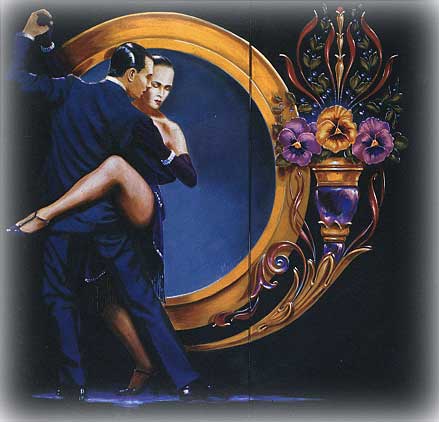
Bill Brauer has studied and utilized the concepts and techniques of Renaissance masters while adding a distinctly modern edge to each painting. The work is more about shape and placement than story telling. A single light source allows him to plan and control light and dark patterns in each piece. His female figures are provocatively situated into these design elements becoming the narrators of each piece.


Evening In Jade

Based on mythological themes, dancing and beauty, Brauer paints as if hypnotized or haunted by his own muse. Sometimes seen as controversial Brauer's women can be viewed as contemplative, erotic and on occasion objectified. Painted in warm earthy colors that cast a glow over each woman, they appear sensual and inviting to the viewer. Brauer feels the art of sensuality is falling by the wayside. He does not necessarily want his subjects to be sexy, but instead sees them as just "natural, beautiful women" but with an air of mystery.

Tango Dancers

Born in New York, artist Bill Brauer started his career as an illustrator and print maker. Upon moving to Northern Vermont over thirty years ago, Brauer found that printmaking limited the size and color of his work so he began to work with oil paints. He has taught at several colleges and schools throughout Vermont and has been a driving force in advocating for artists in the area. His work has been exhibited in numerous shows over the last thirty-two years including the Brooklyn Museum and the Southern Vermont Art Center.

Sunday, October 22, 2006

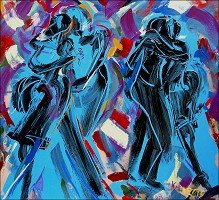
Tango Artist

DORA KANEGIES

A painter and a dancer I have always been, though Tango Passion took hold of me when we met two Springs ago.

I go to milangas with my black and red shoes and my drawing pad. I dance until my feet hurt, then I draw into the magic hours, when the dance floor thins and the dancers float about as if in another world. I draw very quickly without looking at the paper. The lines flow from my hand, directed by my eyes following the dancers and by my body still warm from dance.

Before I paint, I draw for hours watching The Tango Lesson or some other favorite. Then I enter my studio, turn the music up, and dance until I am filled. Only then do I paint directed by the Tango Spirit. What emerges is of me, of the music, of the Tango itself.

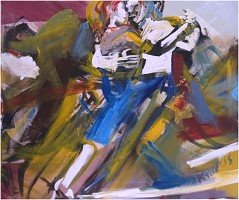
Dora's paintings are an improvisational dance of color created with unconventional combinations of materials. "I enjoy pressing rose petals, faux stones, or lace into thick textured gesso on paper or canvas. I then paint with watercolor, acrylic, oil pastel and oil stick. I work in opaque and transparent layers increasing depth and texture creating a dream-like space." Dvora paints faces, dancers, sensuous nudes, dreamscapes, candle lighting for blessing the light of Shabbat; all are woven with a thread of mystery that engages.

Receiving scholarships to Skidmore College and Yale University, Dvora received degrees with honors and continued to study art with Knox Martin in New York City and others at Columbia University.

Dvora Kanegis paints and teaches the passion of painting and drawing in her studio in Boulder, Colorado and exhibits widely. Her compelling paintings have been exhibited in numerous one person and group shows in galleries and museums through out the United States. Her work hangs in permanent collections at The University of Colorado, Boulder Community Hospital, Healthworks Inc, Bravin Architecture Inc. and many more public and private collections.

In 1999 The International Cable Television Channel featured her work in an international campaign on breast cancer awareness.

Vintage Dance Images


All Vintage Dance Images graphics are available as magnets, blank folded notecards, and 2 sizes of posters. These are reproduced from a private collection of antique postcards and sheet music, most from pre-1925. They come from treasure-hunting sources all over the world. The image reproductions are faithful in detail (no digital alteration), and reveal evidence of the colorful histories, travels, and change of hands of the originals over many decades. Thus, can be seen signs of wear, perhaps a signature of owner or composer, store stamp, edge wear on original, or even minor repairs. These "blemishes" represent their history and, for me, are part of their charm. They are all real treasures.

IMAGES GALLERY here

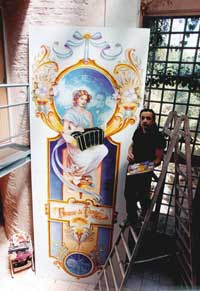
Argentinian Filete

HORACIO FERRERE


Chapter 3: Cat on a hot dance floor

A Tutorial About Argentine Tango Dancing

TANGO, OUR DANCE

One of the often used analogies to describe the motion of Tango dancers on the floor is that they walk like a feline. The subtle, catlike, cunning displacement of good Tango dancers speaks plenty of connection, sensuality and finesse.

How, then, can we learn to move like a cat, while watching where we are going, taking care of our partner and listening to the music? Did somebody hiss, “technique”? Absolutely! As with any other discipline, learning to dance the Argentine Tango requires technique in order to develop a dancing personality of your own. Otherwise, the temptation to imitate others is the curse of the lazy dancer. Think about a handful of world class Tango dancers, Pablo Veron, Miguel Angel Zotto, Osvaldo Zotto, Pablo Pugliese, Eduardo Arquimbau, Carlos Copello, you name them. They all are superb dancers, they all can teach and they all dance completely different from each other. The same thing applies to the ladies: Milena Plebs, Alicia Monti, Miriam Larici, Marcela Duran, Cecilia Saia, Lorena Ermocida, Esther Pugliese, and the list goes on. Spectacular dancers, yet, each one dances with a unique personality and style.

The common denominator is technique. Technique is acquired with knowledge and honed with practice. Of course, we have not overlooked talent, but that is what makes those and other stars who they are.

The beginning of the dance

Many of the unique traits of Argentine Tango dancing are the result of protocols, rituals and habits developed along the line of time since the first man raised his left arm and embraced a woman with his right. The salida, the beginning of the dance, is part of the ritual of Tango dancing.

Traditionally the “best” women dancers were seated in the front row around the dance floor. This still takes place in many popular dance halls in Buenos Aires. The men would either be in the center of the dance floor or near the bar from where they could see and be seen by the ladies. The object was to make eye contact and imperceptibly ask a lady to dance with a nod of the head. A lady wishing to accept the invitation would indicate so with a minimal motion of her eyes, her lips, or her head. At this point the man would walk towards the lady without losing eye contact, a sort of reassurance that the eyes he was looking at, were looking back at him and not for some other guy coming from behind him.

After accepting the invitation to dance, the lady would wait until the man got closer to her table and then she would get up and step forward with her back to the table and facing the dance floor. The man would stand in front of her facing away from the center of the dance floor. The accepted protocol expected that the couple would not disturb the dancing of others already dancing, so their first step would have to be in the line of dance, i.e., the man’s side step to his left, the lady’s side step to the right.

Then, a left turn of the man's upper body would line them up to join la ronda and they would proceed to complete what has became known as the salida, the beginning of the dance, which commonly ends with the cross, but it doesn't have to necessarily happen that way.

Do you have to start with a step to the side? No. Can you start with a back step? Yes. In which of the two situations can you see the space in front of you? Which of the two situations would minimize the possibility of stepping on somebody dancing behind you? Rather than engaging in a philosophical debate over which is the best way to start moving, we suggest that you use common sense. There are some crowded situations where you are almost forced to move in one and only one direction. You may back out of your driveway, but would you back out on a freeway?

The Salida

At the beginning of the dance, both dancers are facing each other and their legs are closed, that is their feet are together. The first step keeps the dancers facing each other but their legs are open. Throughout the dance both dancers will be repeating the same movement, opening their legs, then closing them. This is a simplistic concept yet it is the way we dance. There will be times when one dancer opens the legs while the other keeps them closed or viceversa. Tango dancing requires a mark from the man, a motion by the lady and a subsequent motion by the man. Sort of the way a cat displaces his body by moving one leg at a time. The combined bodies of the dancers and their four legs move in a similar fashion.

Every time we step we open our legs. Every time we bring our feet together before the next step we close our legs. So, stepping to the side is the same as opening the legs wide. Stepping forward or backwards is the same as opening the legs deep.

A very commonly used sequence for a salida consists of a side step, two steps in the direction that the man is facing, and a return to the closed legs position. When the dancers are in the closed legs position, their bodies are fully facing each other. Their feet can be together or crossed.

A typical salida then, consists of:

(1) A side step to the right of the lady. The man's body shifts slightly to the left in order to walk outside the lady.

(2) Two steps, forward for the man and backwards for the woman.

(3) A forward step for the man and a back step for the woman who crosses her left leg over her right to come back into a full frontal alignment in front of the man. This position is similar to the body position the dancers had at the beginning of the salida but now her feet are crossed.

Although the crossing of the lady's leg is a very common occurrence in Argentine Tango, the man has the responsibility to mark such a movement. In fact, every single step of the Tango is marked, and this is a very important subject that we will address next month.

Copyright (c) Planet Tango 1998-2000 All Rights Reserved

Chapter 2: The missing video

A Tutorial About Argentine Tango Dancing

TANGO, OUR DANCE

One of the main resources for Tango dancers is the large number of videos available from various sources. Given enough time and patience, most people could eventually copy and replicate some of the breathtaking moves we see in those videos. However, the majority of reputable experts, some of which make a good living dancing for the cameras, will tell you that nobody has ever learned to dance Tango from a video. A video should be a tool similar to the notebook or handbook we used at school, its purpose being to refresh in our minds concepts learned in class, to observe the correct demonstration of an exercise or a sequence of steps and to be a reference source for consultation.

Videos used to watch other people dance are very popular and people insist on buying them with the hope that the magic annointment will come to them by some sort of esoteric transfer from the screen to their bodies. The one and only video we all can certainly use is missing most of the time from our videotheque. It is the video where we see ourselves dance. Reality check they call it, because as we spend a lot of time watching and attempting to imitate visually, we fail to see ourselves and therefore we can’t firgure out why some things are just so difficult to accomplish. Or even worse, we dance our way to the milongas with the wrong opinion about ourselves.

One of the end results is the large number of men who blame their partners for their obvious lack of balance and the inability to execute the way the video demonstrated.

The Posture

At the opening session of the last Stanford Tango Week, young master Pablo Pugliese began his five days of classes by saying “the Tango begins with the posture and it ends in the legs.” Then he proceeded to enumerate several principles which we have heard from various masters as well.

Each dancer must find his and her axis and each must be capable to move without throwing the other out of balance. Simple, yet hard to implement.

There is a visual illusion that makes us believe that the execution of figures and patterns are always done with the body weight on the opposite leg than it actually takes place. Unless we understand the dynamics of the embrace, and how torso, arms and shoulder interact, we run the risk of imitating what we see in the videos placing our body weights on the wrong side of the figure.

The Dynamics of the Embrace

The Argentine Tango dance requires that men and women embrace and move around in unison.

The embrace symbolizes the union of two partners determined to care for each other while enjoying the moment, the music, the floor, the surrounding dancers and each other’s company. The contact makes for pleasant sensations but most important, it provides the means for the transmission of signals that are needed for safe navigation on the dance floor and smooth execution of the dance.

To begin with, both dancers start by standing in front of each other about a foot apart. As they ready to assume the embrace, their body weight gets transferred to the metatarsus area of the foot, commonly known as the ball of the foot or the base of the toes. This produces a natural lean so the upper bodies can come into contact at the chest area.

The right arm of the man is locked at the shoulder as he surrounds the woman’s back by placing his right hand with closed fingers on her left shoulder blade. The woman rests the upper part of her left arm on the upper part of the man’s right arm so she can feel the mark produced by the moving action of his right arm and shoulder. Her left hand should rest softly on the man’s shoulder but it should not exert any kind on pressure or be used for balance or leverage because this will inhibit his freedom of movement and it could contribute to throw him out of balance.

The final link to complete the embrace is the man’s left arm which extends straight out from his shoulder with the elbow bent at about a ninety degree angle. His hand opens in such a way that the woman can make palm to palm contact. His fingers close gently to hold her right hand in place. Both man and woman’s shoulders should be locked so there is no separate motion from the body and the arms.

If the embrace is approached in this fashion, any subtle motion of the man’s upper body will be felt very clearly by the woman, and her upper body will move accordingly. Since feet follow the body, a dynamic interaction of the upper bodies result in a visually pleasant and smooth displacement of the dancing couple.

During the dance, the woman always walks forward or backwards on a straight line, meaning that her leading leg should always move in the direction her body is facing. It follows that to turn, the body must change direction first (using the pivot or swivel of the supporting leg) before the leg moves in a straight line in the new direction.

The man walks with the woman always in front of him, whether he moves to her right or to her left. This is very important to understand. The woman must walk in a straight line. The man can then walk straight in front of her, to her right or to her left.

Having said that, walking for both men and women means adopting a posture that will be both comfortable and elegant. Because of the natural lean adopted at the beginning of the dance, the man will always move with his upper body first followed by his legs attempting always to keep his body weight in the middle not favoring either leg. This concept is important as many already know one the most basics figures of the Tango: the parada followed by the sandwich.

Deficient teaching techniques ask the dancers to “sit” on the support leg making it impossible for that leg to respond on cue. Here is where learning by watching, as popular as it is, is misleading. Argentine Tango is a dance of fluidity and continuity. A man can stop the woman (parada), sandwich her foot, and immediately mark a boleo. The woman cannot respond if her support leg is nailed to the ground with her entire body weight on it. Had she been in the middle, she could boleo and continue dancing without breaking the continuity and progression of the dance.

So posture is important and leads to good balance. The lack thereof is the main reason why we have so many problems replicating what we see on video or putting into practice the mass of knowledge some have accumulated over the years.

Dancing into the embrace

When the woman is properly embraced by the man, the contact that she feels enables her to dance or move "into" the man’s right arm when taking a back step. The woman should attempt to keep contact with the man’s arm while walking back, and especially on the back step of the giro where it is necessary to generate a centrifugal force. It is very important that the man also keeps contact and a connection that can be clearly felt by the woman. When the woman is turning to her right she dances into the direction of her own arm. As the man is turning, he opens his left shoulder a bit, making the space for her to dance into.

Chapter 1: Stand up straight, embrace your partner and walk...

A Tutorial About Argentine Tango Dancing

TANGO, OUR DANCE

In the land of the do-it-yourself and the cult of self-reliance, those of us who decided to learn to dance the Argentine Tango are constantly lectured on the "unstructured and improvisational aspects of this urban dance," and then we are immediately bombarded with an endless array of steps, figures and Spango, a list of Tango names that are supposed to help the English speaking students memorize steps and patterns better. Adding to the mystification of the "unstructured and improvisational dance," are the myriad of traveling “teachers” who carry suitcases full of steps, judgments and ego. At the local level, there are a few methods and systems in circulation that contribute to the bedlam that most “beginners”, “intermediates” and “advanced” level dancers face on a daily basis.

When Humphrey Bogart asked Lauren Bacall how does one whistle, she responded, "put your lips together and blow..." Had he asked her how do you dance the Tango, she might have said, "stand up straight, embrace your partner and walk..."

Yet, after almost ten years since the Argentine Tango fever caught this nation by storm, the general proficiency and the overall quality of the social dance leaves a lot to be desired. Everybody is a performer at heart and the local milonga is the stage to make the dream come true.

Americans are an independent lot, quickly given to instant gratification with a penchant for fixing things that are not broken. As a result of that, the important aspects of systematic learning and the hard work that goes along with that, are easily overlooked and in the few cases where a syllabus or courses have been developed, the tendency has been to catalog a lengthy list of steps and figures which then are used to pigeonhole people according to their capacity to memorize and repeat the steps and figures using a ranking system similar to the ones used by the American and International Ballroom community.

If we accept the fact that the Argentine Tango is an urban social dance that has been in existence for over 100 years, and if we acknowledge the fact that throughout several generations of dancers the core concepts and elements of the dance have only changed as society mores have allowed more freedom of interaction between men and women at the social level, then we may open our minds to a series of concepts, vocabulary and structural forms, that in many different ways, we have learned at one time or another from some of the most talented and gifted dancers and teachers from Argentina.

Putting aside the silly jealousy, envy and down right competitiveness among the masters and the journeymen that follow them, (traits that, if used with caution, you’ll see soon are a necessary ingredient for the attitude required to absorb the Tango in your organism) we are able to rescue fundamental concepts that compiled in a didactic context, may form the basis for a "dancer's manual" of sorts. To that extent, in instances where specific concepts or ideas identify a particular individual we will give the appropriate credit.

The basic structure of the Argentine Tango dance

At the very core of the dance structure, we may define and identify four distinctive set of movements: the Salida, the Caminata, the Giro and the Cierre. Each one will have variations, substructures and exceptions but as we pick apart each one of these elements we will discover what Mingo Pugliese calls "the embodiment of the Tango". That is, out of a finite number of recognizable body positions for the couple, it is possible to improvise a countless number of patterns, steps and figures.

The Roles Dancers Play

During the learning process, both men and women must understand that their responsibilities on the dance floor are quite different. Firstly each one must assume control over their own balance, which translates to finding the correct axis in order to develop the most comfortable posture. Second, both the man and the woman must learn and understand the concept of marking (La marca). This concept is unique to the exhilarating experience of improvisation on the dance floor and unfortunately for many confused dancers in this country, is commonly replaced with the ballroom concepts of leading and following. The confusion has been aggravated by some Argentino teachers who don’t bother with pinpointing the radical difference between marking and leading and following because of expediency, selfishness or ignorance of the conceptual language differences.

A Thesaurus search of the verb "to lead" will produce the following partial list of alternatives: to guide, to usher, to steer, to drive, to direct, to conduct, to escort, to precede, to go before...

We ask the men, regardless of experience, when was the last time you “led”, "drove", "ushered", "went before" your lady partner on the dance floor? According to Rodolfo Dinzel and others who corroborate this concept, the woman always moves first and the man follows right behind (the notable exceptions are the not-so-gentle-men who charge ahead with their feet, dragging the women like a sack of potatoes. They are actually “leading” the lady to believe that they care little for their partners).

The Three Steps of Tango

One of the understated facts of dancing Argentine Tango is the availability of four feet and four cardinal directions where the couple can move. Simply put, there are only three steps in Tango: the Side step, the Forward step and the Back step. The direction is relative to the orientation of the upper body.

Step Aside

A side step is typically shoulder wide and in the direction of either shoulder. In other words, it is a lateral movement that begins with the leading foot extending right or left, followed by a body weight change to that foot and ending with the unloaded foot coming together with or without another change of weight (this will be dictated by the next movement).

Being forward

A forward step requires similar mechanics only that the leading foot advances in the direction where the upper body is pointing. Once that the leading foot’s metatarsus has found the ground, the body weight transfer begins with a slight flexing of the leading foot in order to “pull’ the body weight to its axis. This avoids the “bouncing effect” that occurs when the body is “pushed” by the trailing leg. Once the weight transfer has been completed, the heel of the trailing foot is off the ground and the trailing leg is relatively elongated. Then, and only then, the forward step is completed by letting the trailing foot “fall” next to the support foot. At this point both knees are together and slightly flexed ready to continue.

Know When to Back up

A back step is executed in the reverse order. First the leading foot moves back in the direction where the back of the upper body is facing until it finds the floor with its metatarsus. Then, as the heel touches the floor, the leading leg “pulls” the body for the weight transfer at which point the trailing foot “falls” next to the other ready for the next movement.

A Position of Strength

The position where one leg is slightly flexed with the foot completely on the ground and the other leg is elongated with the heel off the ground is perhaps the one most likely to be in use most of the time while dancing. Should somebody enter the room and take a still photograph of that position, it would be impossible to guess whether the dancer is in the process of stepping forward, stepping backwards, or in the middle of a left or right hand turn.

With these three steps a couple could dance in straight lines or in a box, going forward, sideways, backwards, sideways, etc., etc.

In order to turn one more element is necessary: the swivel or pivot, which is a rotation of the upper body along the vertical axis of the supporting leg and executed by flexing the knee, lifting the heel of the ground and spinning on the ball of the foot.

A sequence consisting of a forward step, a pivot on the leading foot followed by another forward step is the most popular Tango figure universally known as the Forward Ocho.

Likewise, a sequence consisting of a back step, a swivel on the supporting leg with both feet together followed by another back step is commonly known as a Back Ocho.

Finally, we'd like to quote Pablo Pugliese: "the Tango begins with the posture and finishes in the legs". There is an anatomical and a psychological reason for paying attention to posture. From an anatomical point of view, finding a comfortable embrace helps the enjoyment of the dance.

The psychological aspect involves a positive winning attitude. The dancers must believe they are the best they can be.

Copyright (c) Planet Tango 1998-2000 All Rights Reserved


A Tutorial About Argentine Tango Dancing

TANGO, OUR DANCE
This is a series of articles published periodically in El Firulete, The Argentine Tango Magazine by Alberto Paz and Valorie Hart. The information is based on their own experience, first as students of the dance and second as teachers of Argentine Tango around the United States. Copyright (c) 1998-2006 Planet Tango.

Chapter 1
Stand up straight, embrace your partner and walk...
Chapter 15
The Salida Cruzada
Chapter 2
The missing video
Chapter 16
Body language
Chapter 3
Cat on a hot dance floor
Chapter 17
Raising the bar
Chapter 4
Mark me, she said
Chapter 18
Putting the Tango on a solid base
Chapter 5
What Tango shall we dance?
Chapter 19
Dancing on a crowded floor
Chapter 6
Once upon a Tango
Chapter 20
All Roads Lead to Tango
Chapter 7
Glancing is not stalking
Chapter 21
All About Eva
Chapter 8
Dancing with freedom
Chapter 22
Riders of the man's mark
Chapter 9
Consensual Tango dancing
Chapter 23
A Giro state of mind
Chapter 10
Fear of learning
Chapter 24
Picking the lock (step)
Chapter 11
Myths and Misconceptions
Chapter 25
The Great Equalizer
Chapter 12
Sacadas are body displacements
Chapter 26
All Aboard!
Chapter 13
The thorns make my lips bleed
Chapter 27
It's what counts
Chapter 14
The Media Vuelta
Chapter 28
Whatever, whenever

Watch your step with the tango: It's addictive

By Margaret Putnam / Special Contributor to The Dallas Morning News

I'd been warned. The rapids are treacherous and the current swift. Once you step in, watch out. It doesn't take long to be swept away.
Those rapids - otherwise known as the Argentine tango - have claimed plenty of victims. Valorie and Alberto, for instance, gave up lucrative careers to tango. Beth resisted for a while, quitting, returning, quitting and now back at it. Eiko is definitely a goner - she took up tango four years ago and soon found it impossible to return to Japan.

I fear I'm next. Already I've skipped two ballet classes, rushed from a flamenco show to get to a Sunday afternoon session, plunked down $60 for a private lesson, practiced tango steps on the streets late at night while walking the dog and danced on and on despite feet that ache so badly I wonder if I'll make it to the car. And it's not even a week.

Only last Friday I had laughed when Leonard responded to my question about what other kinds of dances did he do. "Tango is the only dance," he said.

I think he's right.

Tango is the Everest of social dance. Impossible. Demanding. Intricate. And therefore irresistible.

"The geometry, the navigation and the balance captivate men," says Valorie Hart, who with her partner, Alberto Paz, is in town to teach a three-week tango workshop sponsored by Tango Argentino Dallas and the city of Dallas.

"Engineers go wild over the infinite mathematical possibilities." She mentions likewise lawyers, architects, artists. "Tango has become the darling of the professional classes. In the old days it was the working class and the middle class."
People who spend too much time staring at computer screens and talking on cell phones discover, through tango, the heady pleasures of physical reality. Suddenly, the body counts for something. And the isolation and distance built in to most forms of modern work disappear in a flash the minute a man steps forward to embrace a woman.

With that embrace, the rest of the world falls away. The music takes over. Even in the cold florescent glare of KC Dance Studio where some of the workshop classes are held, my partner listens, I listen, both of us waiting for the moment to take that first smooth step to the side. Then I'm moving backward, to the side, forward again, gliding like a miniature liner through unresisting ocean.

"Stay connected," Alberto exhorts, surveying the dancers from the middle of the studio. The tango requires uncanny cooperation between man and woman and woe to anyone who loses focus. This is not the fox trot or the waltz, for which you learn a pattern and repeat it, ad infinitum. There are steps and patterns, to be sure, but they're only a base, and the possibilities of variation are infinite. To tango is to improvise, and to improvise with a partner requires intense concentration.

Not that we start out in the workshop improvising. Alberto starts us with the basics: the tango walk, a stealthy stride placing one foot directly in front of the other, thighs crossed, upper body moving slightly in countermotion. Then the side-back-side-front pattern.

We practice, and practice and practice. Amazing how much there is to learn, about balance, keeping connected, turning out the legs ever so slightly on the side step, shifting the weight, keeping the rhythm.

Overconfident at the end of the second lesson - after all, I've had decades of ballet training - I approach Alberto with a question. He eases me into his arms. I move before he does. "No!" he barks. We start over. "No! Why are you swinging your leg?" he says. We begin again, and once more, before we get to the end of even a complete pattern, I've done something wrong. "What are you doing?" he asks incredulously, trying to explain that the leg doesn't initiate the movement - my wonderful ballet training - but the upper body.

The two-minute lesson is a revelation. And after that, every time Alberto glides over to me, hand outstretched, I quake, ego on the line. But each brief encounter yields tremendously helpful information, and I improve on the spot. Think what a private lesson could do, I reason, and Tuesday I find myself in the Oak Lawn apartment where Alberto and Valorie are staying and spend 90 minutes dancing with him on a slick wood floor. Not only does he not bark, he is so warm and encouraging I begin to understand why Valorie ditched her New York business five years ago to take up the tango life with him.

"My friends in New York thought I had lost my mind," Valorie says. "I had a beach house in the Hamptons, a studio and an apartment. I gave all that up. My friends thought I was going into white slavery. I've never had those issues of submission. A kind of courtliness arises with the tango. We're all in this together."

The "togetherness" aspect of tango, in fact, is its most striking characteristic. The battle of the sexes may rage elsewhere, but not on the dance floor. The man and woman either cooperate or stop dead in their tracks. Alberto doesn't even like the terms "lead" and "follow."

"Lead and follow imply we are doing something we both know," he says. "But the moment you are improvising, you can't lead or follow. The woman moves first, the man responds and creates the space for her to dance. It's not even 50-50, it's 100 percent and 100 percent from both of them."

Tango is too intense to permit small talk. In three group lessons and a tango party, I learn nothing about any partner other than name and tango history and often not even that. I have no idea what Leonard, Mac or Carlos do for a living, whether any of them has been indicted for fraud, been married six times or plays the horses. Nor do I care. Can he dance is the only burning question.

The single-mindedness of the tango fanatic extends after class, too. After the second lesson, about a dozen of us repair to Goldfinger's restaurant nearby. The band plays Greek bazouki music, and in a flash, the dance floor fills with couples doing - what else? - the tango.

And who can bother eating? At the milonga, or tango party, Saturday night, two tables filled with food at 9 p.m. are still filled with food at midnight. When Astor Piazzolla's music is playing, "to dance or to eat" isn't a hard choice.

"When I first signed up for tango lessons," Valorie says, "I thought, how hard can this dance be? I can fake it. That first lesson was like 'Whoa!' I'm not going to be able to put on a cute dress and cute shoes and think that will cut it."

Watching Alberto and Valorie move together in their infinitely smooth and subtle way, I'm heartened. Valorie took up tango only five years ago, and look at her now. True, she has her own Argentine partner, a charmer, but I'll bet she'll tell me where to buy some sexy tango shoes.

Margaret Putnam writes about dance for The Dallas Morning News.

Flirty Dancing

From the December 24-30, 1998 issue of Metro.

Copyright © Metro Publishing Inc. Maintained by Boulevards New Media.

Tango has been called the three-minute romance, and a thriving circle of aficionados says the late-late 20th century is the right time for its passion and perfection

By Jim Rendon
Photograph by Christopher Gardner

Dance of Life: Sunnyvale residents Valorie Hart and Alberto Paz found each other through tango and now teach others in a thriving Bay Area scene where a milonga can be found any night of the week.

Valorie and Alberto

VALORIE HART LOOKS out on the empty dance floor, watching as couples arrive, a few at time. She reaches across the table and grabs for an Altoid. "These are addictive," she says, popping a bright-white mint in her mouth from one of the little red-and-white tins that seem to be everywhere. Tango is a close dance.

Dressed in a glittering black shirt, fishnets and a short skirt with a long slit, Hart keeps turning her attention to the floor as she talks. Her dark hair is slicked back, cut straight at the neck. Though her eyes look sleepy, her conversation is sharp and entertaining.

"With tango, you are either in or out," she says, turning away from the floor. "Family and non-tango friends don't understand. My friends in New York thought I was white-slaved away. I sold my business, gave up my apartment. But I did not really give up anything," she says. "I have a great life with Alberto. We embrace this community."

On the dance floor, couples move tentatively in a counterclockwise walking embrace. Clearing his throat, Alberto Paz brings the studied movement of five couples to a halt. "OK, now we'll try something different," he says. Valorie's 55-year-old partner has an air of grace about him that makes his maroon tuxedo jacket and white silk scarf look comfortable, almost casual. "Like this," he says as he and Valorie embrace, face to face, and move in exaggerated motions to the melodramatic rise and fall of the music. Even in their overblown instructive performance, their connectedness is unmistakable.

Alberto steps across Valorie with his right foot, then brings his left foot toward her. They move to his right and stop, shifting weight back to his left. "Go on, try it, try it," he says. And the circle of dancers moves again.

Each Monday night Paz and Hart drive from their home in Sunnyvale to share tango with everyone who wants to learn, from the advanced, invitation-only crowd decked out in dark suits and slicked-back hair, to dance-floor virgins in rubber-soled shoes, like me. As with many of the people who are filtering into the room, tango has enriched, changed and utterly consumed their lives.

Five years ago, Hart and Paz lived on opposite coasts, each unaware of the other, wrapped up in successful business ventures of their own. Today their careers lie abandoned, their lives bound to each other and to the dance that brought them together.

Since meeting and falling for each other, Paz and Hart have been an important part of a decade-long Bay Area tango obsession. This is the hottest tango spot in the United States, and some claim the hottest in the world outside Buenos Aires. On any night of the week, tango-obsessed dancers can hit a milonga (social dance) somewhere in the Bay Area. Homegrown teachers have sprung up to support the craze. And many Argentine masters work their way through town, arranging invitation-only classes through Paz and Hart.

The dance--close, passionate, sensual, demanding a physical connection--expresses a side of the human experience that Silicon Valley turned its back on. Engineers locked in a mental embrace with numbers, theories and codes have traded sensual experience for platonic flirtation with a machine. Tango, Paz says, can help fix that. "Silicon Valley is populated and run by engineers, people who have a love affair with the keyboard," he says in a deep voice that masks a distant accent. Tango is refreshingly different. "The first thing you do is to embrace a total stranger, keep your mouth shut and listen to the music. You learn to listen to your partner, to know what they are feeling. It is a shocking and devastating experience. These moments of sheer connection are important," he says, especially in a valley where people are increasingly alienated and cerebral.

DICK SIMONI, a Menlo Park architect, sits down at a long table dotted with glasses of wine and tall draughts of ice water. He moves a few glasses aside and puts his small canvas bag on the table. His back to the dance floor, he pauses to take in a stunning view of San Francisco's rolling hills, fading into the gridlike outer Richmond. From the 19th floor of the Mark Hopkins hotel on Nob Hill, the city unfolds in every direction. Simoni turns his gaze back to the table and pulls a pair of leather-soled dance shoes from the bag, swapping them with his formal footwear.

At the sound of tuning violins and the sighing bandoneon, the Argentine accordion, people begin to mill about at the edge of the dance floor, picking out partners, anticipating the evening's first dance to the live band. While most milongas have a DJ, Paz and Hart have booked Strictly Tango, a five-piece band, to bang out Argentine tunes every Monday night.

Like most of the men in the club tonight, Simoni wears a dark suit, his hair brushed back off his forehead. He looks around the room, enjoying the view, the potted palms and wood pillars that hem the dance floor. "We like to imagine this is a 1920s Berlin nightclub," he says. "Today in Europe, it's more underground," he says, describing the warehouses he and his wife, Ginger, danced in during a recent trip to Switzerland, as the band starts playing and the dancing begins.

The band starts with a stereotypical tango song. It's the one that I hear in my head when I think of tango, a jerky beat, soft and then loud. It has the rhythm of someone frantically sneaking up a staircase--a quick run, then a pause to check if someone is listening, then another burst up the stairs. It's almost comic, reminding me of Charlie Chaplin's slapstick, until suddenly the music slows, becoming sad, almost tragic. Even the fastest, most upbeat tangos the band plays have an edge of sadness and tragedy.

Simoni points out a couple moving past, their chests pushed tightly together, legs pushed out so they look like a triangle. "That's miloguero style," he says, admiring the couple's performance. The tight embrace and subtle foot movements evolved from the tightly packed milongas in Buenos Aires.

A woman in a long black dress pauses at the table and asks Simoni to dance. Standing chest to chest with the woman on the dance floor, Simoni waits for the music to move him. Then, on the downbeat, he steps away, tangoing with the others, adding his own slide and shuffle of leather against wood to the quiet sound that flows just beneath the surface of the music.

Tim Yoshida watches another young woman whose arms are draped over the shoulders of a tall, older man. She stretches to reach him, but the couple looks graceful nonetheless. "She's only had something like three or four lessons," Yoshida says. "But she's danced just about every song all night. She's hooked," he says with a laugh.

Yoshida, like a lot of dancers, talks about two things: the sensuality of the dance, and something dancers call the tango trance. Yoshida studied martial arts for 10 years before trying tango. After three years of dancing, he finds it fills the much the same need as martial arts. "In the beginning, you work on posture and try not to fall down," he says. But once you get comfortable with the footwork, the dance changes. "You are torso to torso, hand to hand. It's up to you to lead. If you lead and she follows, you become lost in the music. You are transplanted to another time and place."

Sitting across from Yoshida, Caroline Duncan agrees. But for her, the spirituality gets wrapped up in the physical, sensual nature of the dance. "With tango, you meet a man right here," she says placing her hand flat across her chest. "It's a touching way to meet a man."

Duncan takes a sip of her drink and looks out on the floor, watching for a minute as dancers pass. Everyone is engaged in their own world, creating their own steps. Some move slowly, deliberately, with long pauses. Others stamp by quickly, swinging and kicking feet in the air. Though everyone moves differently, the dancers flow together. Always the couples stay close, never leaving the embrace.

"It's a dance for people who like to touch," she says. "When you first start a dance, you press your shoulder up tight against them and listen to the music. You can feel the music, your partner's energy. You can tell a lot about the quality of the person you dance with. It's synergistic. Together you are more than two."

The dance, she and others say over and over, got its start in the brothels of Buenos Aires. Some call it the three-minute romance. Though it quickly left the bordello for Argentina's society nightclubs, the heart of Argentine tango never strayed far from its passionate working-class roots.

TIM RISES TO GET IN a dance or two with the young woman. As he leaves the table, Jim Maes, a slender, bearded man in a dark suit, approaches the table. He says a few somber hellos, then crosses to the other side of the room, where he sits alone with a full glass of red wine, watching the dancers spin past him.

Maes is a casualty of tango. Tonight he looks back on his five years of dancing with a wrenching mix of joy and despair.

Maes began dancing after seeing Forever Tango, a Broadway-style show featuring some of the best tango dancers in the world. "I saw it three times," Maes says. "It brought tears to my eyes."

Maes had a nearly instant reaction to the show and the dance. "I know that," Maes said to himself as he watched the proud attitude of the dancers, the tough stance and macho clothes. As a teenager Maes had been a greaser, knocking around San Francisco's Mission District. The tough, proud attitude reminded him of the street. The lure was irresistible. He jumped in head first.

Maes would take classes as often as possible, sometimes six times a week. "I fell in love with the beauty of the dance, the passion and the power," he says.

Maes left his most recent job so he could dance more often. Tango has taken over his life, and Maes feels lucky to give himself over to the dance. "It's a way for me to express myself," he says. "It's been a long, hard struggle to get to where I am now."

But now that pride is tainted. "The dance is so seductive," he says. At a recent milonga, Maes' dance with a stranger went too far--extending beyond the dance floor. The relationship with his longtime girlfriend came tumbling down around him. Now he hates himself for what he did and for what he has lost.

Yet tango draws him back. "It has brought me so much joy," he says of the dance. "But it has also brought heartache. I wish I never found it. I wish I could cut myself off at the knees and never dance again," Maes says, looking at his untouched glass of wine.

Simoni walks over to offer Maes a sympathetic pat on the shoulder. An older woman extends her hand to Maes, offering a dance. He accepts, taking the floor. But he moves stiffly, his thoughts elsewhere.

MAES HAS AN UNUSUAL dedication to the art of tango. But for anyone to master even the basics takes time and some commitment. Learning to dance well is like learning to play jazz music. Tango is less about learning individual steps than about understanding body position, knowing what range of movement to pursue from any given position, and learning to give oneself over to the music. Like jazz, the form allows an infinite range of personal expression. It can take a lifetime to master. Women take about a year to feel comfortable, Hart says. Men can take two years before they are confident on the dance floor. For me, I think it would be longer.

As couples circle the room under Hart and Paz's direction, she can't resist giving me a little help. With her fishnet-clad legs bowed as if straddling a Brahma bull, Hart stomps away from me. Her hands rest on her hips as she swings her chest back and forth exaggerating a swagger. "Don't walk around like a cowboy," she says to me, a grin creeping across her face.

"You want to keep your feet together, place them right next to your partner's as you move," she says, grabbing my shoulders and moving me around with unwavering physical certainty. "Feels better, eh?" she says, cracking a smile and walking off toward another couple. I am left to work out the rigorous act of walking with my partner.

Though we attempt little more than walking counterclockwise, I feel as if just putting one foot in front of the other is beyond me. But I am assured over and over again that everyone feels lost at first. Even Alberto, who grew up in Argentina surrounded by the dance, felt awkward when he took his first steps less than decade ago. For the first six months he found the dance a trial.

Paz moved to the Silicon Valley from Buenos Aires in 1968 seeking a future in electrical engineering. For the next 20 years he worked for small high-tech video companies, finally founding his own in the 1980s. But by the end of that decade, Paz felt there was something missing in his life.

He began working at KIQI as a soccer announcer and eventually as a night-time DJ playing South American music. Every now and then he would spin a tango from the station's collection and the phone lines would light up. The music brought back memories of home from listeners who grew up all over South America, and they wanted to hear more.

Soon he switched to an all-tango format. To gear up for the show, he took a two-week trip to Buenos Aires, snatching up books and music, absorbing the history and culture of the music. "I learned a lot of things that were already somewhere in my mind," Paz says. "For the 25 years I lived in Argentina, I totally ignored the tango I heard every day at home. I liked rock & roll."

What Paz uncovered was a rich history of music, dance and culture that was largely undocumented. At that time there were no English-language histories of tango. The first was published just a year ago. Even Paz, who tracks down the dance's roots with a disciple's fervor, feels uncertain about many of the details.

Italian immigrants and recently freed slaves living in and around Buenos Aires (which was a slave port in the mid-1800s) developed the earliest form of tango in the 1860s. Paz says that the dance may have originally been a spinoff of high society's ballroom dancing which gave immigrants, penned up with little work and few resources, a chance to develop and show off their grace and skill. Initially, most of that showing off was done by men dancing together, because the flood of immigrants was largely male.

By the early 1900s, the dance moved from the streets to bordellos, where men lined up to take turns dancing with the women. The music developed an upbeat, seat-of-the-pants style, played by working-class musicians without the benefit of sheet music. From the bordellos, the dance began to spread upward through Argentine society.

Sailors took the form to Europe, where it caught on like wildfire. And once Europe embraced it, Argentine society grabbed hold of the dance, creating nightclubs and smoothing over some of the raunchier moves. When depression hit in 1931, tango went with it, falling out of favor for the first, but not the last, time.

A few years later, in 1935, musicians dramatically changed the songs, emphasizing the rhythms and making it easier to dance to. The crowds came pouring back. Tango hit its golden age from the late 1930s through the 1940s.

Though diminishing in popularity, tango remained strong among working-class people until the 1970s, when Argentina lived under a dictatorship. Paz, like most in his generation, just missed out on tango. The foreign influences of rock & roll were more appealing, and the tradition seemed on the wane.

With the fall of the dictatorship in 1983, a show called Tango Argentino was organized in Buenos Aires. Many of the old masters took the stage. The show toured the U.S. and Europe and helped to rekindle interest in the dance. When Forever Tango came to San Francisco in 1994, it was scheduled for four weeks and stayed for 92.

Now Buenos Aires is packed with tango tourists. The government officially sanctions the dance. People around the world from New Zealand and Japan to Germany and New York dance tango.

Inspired by his trip, Paz returned to Sunnyvale ready to play more tango music. Soon he was DJing milongas and classes, but he never danced himself. "I had the prejudice that tango was something you learned when you were a kid. In Buenos Aires if you weren't good by 18, forget it. If you didn't know how to dance, then a woman wouldn't dance with you."

After a while, Paz learned a few steps, but never really applied himself. Then, at a milonga one night, he realized he was the only Argentine in the room and he was not dancing.

That night Paz made a commitment to learn tango. Like so many other Argentinians, he was rediscovering what his parents already knew.

Within six months, he began to think there was hope. That was in 1993. Two years later, on a whim, he went to Stanford Tango Week and saw Hart leaning against a dance studio door.

WHILE PAZ WAS discovering tango, Hart was living a successful life in New York, running her own business, oblivious to the dance that would change her life.

One night while she was making a pasta dinner with a group of Argentine friends she met through her corporate event­planning business, someone put on a tango album. An Argentine friend boasted that he would teach her tango. But it only took a few steps for them to realize that no one in the room could dance it. As with Paz, the dance had passed these Argentines by.

They promised to take lessons, and Hart's interest was sparked. When she heard about Stanford's tango event, a two-week-long, eight-hour-a-day tango celebration featuring some of the world's best dancers, she had to check it out.

She showed up in Palo Alto just curious, not looking to change her life, meet anyone or fall in love. But then she danced with Paz. "Not till I met Alberto did I feel comfortable dancing. He produced a safe haven for me to dance," Hart says. They danced and talked and got to know each other. At the end of the week they parted, keeping in touch via email and fax.

"Tango touches people at crossroads in their lives. There is something deep about the experience of connecting with someone. My mother had just died at the time I was introduced to Argentine tango. She died young and suddenly," Hart says. "That made me realize that life is short. I am approaching my 50th birthday and suddenly I thought, where did 50 years go?"

Three months later, Alberto visited her in New York and asked her to come to Sunnyvale.

"I thought, am I nuts? I don't even know this guy," Hart says. She packed her bags and left New York behind.

HART AND PAZ TAKE the floor together after an evening of mixing partners. The couple share a dance--slow, deliberate, so close together that they snuff out the light between their bodies. They circle the nearly empty floor as others look on.

The dance holds a deep meaning to nearly everyone here. For Hart, a child of the '60s who has run her own business, the issue is about fitting the dance with her feminist background.

"At face value, it looks as though it is traditional role-playing--a man's dance," she says. "But it's not. The man navigates the dance. In following, you get to improvise. The man creates the space for you to dance in. Once that space is secure, it is a place for you to express yourself, to experience the music, to be feminine."

Alberto finds the social nature of the dance addictive. "People come together and share three minutes of true 50-50 cooperation between a man and a woman. The body communicates. The man improvises and feels the woman's responsiveness. It requires commitment, more than going out and listening to noise and drinking alcohol."

Both Hart and Paz dropped everything to be with each other, and not long afterward they started a company, Planet Tango. They publish a magazine, El Firulete, and are in the midst of installing a dance floor in their home. They teach, broker lessons for visiting masters, arrange tours to Buenos Aires, and sell CDs, shoes and anything else related to tango.

"I'm living the life of a boho gypsy. It's like being 18 again," Hart says. "We are poor, but we make enough for house payments and to make a little pasta." The couple travels almost half the year. In the next few months they are scheduled to teach in Honolulu, Alaska and Florida. Every summer they take a group to Buenos Aires, all to dance.

"It is an obsession," Paz says. "You incorporate tango into your life. In many cases, it's like a religion."

As the floor clears, the band packs its instruments. Paz spins a few more CDs. A crowd watches from the sidelines as the dancers from Tango show off their skills. Some couples dance furiously, some slowly, with exquisite yawning movements.

The dance, which these people perform so well, seems to spark obsession in everyone it touches. Casual dancers are hard to find, and those who work at the dance are close. Tango, born at the end of the last century, fills a void that has opened up over the past hundred years. Once a release for the massive dislocation and upheaval of the industrial revolution, it now provides a vital link to that remarkably sensual world, a world that this century has left reeling behind it. Here, at the Top of the Mark, as I watch architects and mechanics, attorneys and students, lose themselves in the music and the feel of each other, the dance feels like an embrace of the waning century, a retreat from the gaping emptiness of the next millennium. Looking around the room, it seems obvious that we will need to bring tango with us.

As the song ends, Hart walks out onto the dance floor. It's nearly 1am. She calls out loud and happy, "Last tango!"