Contents

Showing posts with label History. Show all posts

Wednesday, January 17, 2007

Florencio Sánchez and the "canillita", reason of a tango inspiration.

By Néstor Pinsón (from Todo Tango)


In January 1, 1868 Dr. Manuel Bilbao did something that can be regarded as a breakthrough for journalism. Up to that time newspapers were sent to their subscribers by mail, or they were bought at the printer's shop itself. But when the paper "La República" appeared for the first time, founded by Bilbao himself along with Alejandro Bernheim, citizens were surprised by hearing for the first time in downtown streets the voices of some boys crying out: «La República at one peso!». But not only the street newspaper vendor appeared but also the shock of an important discount. It meant a great success and soon was imitated by his colleagues. The innovation crossed the borders and it even reached France.

Gradually permanent street stands were installed and soon the number of boys agile and strong to run along the streets a race against time came to spread as soon as possible the impact of news, many times exaggerated or half made-up. The boys found their task restrained by the abundant presence of kids; it was a time of misery, of an alarming lack of jobs, so the kids brought the possibility to get some more cents for their income to many families. Furthermore they were sought after because they were faster and more daring than the older ones.

They swiftly got up and got off streetcars -their preferred vehicle-, they left one and immediately caught another, without caring for its direction and making exclusive use of their intuition for sale.

A new character had appeared in the landscape of the city of Buenos Aires and quickly the same happened in the cities of the interior of the country. But the street newsboy had not still the name that distinguished him in a special way. We had to wait until 1904 for that.

The word "canilla" derives from the Latin word "canella" that is the diminutive of "canna", cane in Spanish. The dictionary defines the term: "the long bone of legs and arms".

On January 17th, 1875 Florencio Sánchez was born in Montevideo.

Since he was 16 he devoted to journalism working for different Uruguayan media and when he was still very young he decided that his future was in theater, he dreamed of becoming a playwright.

He arrived for the first time in Buenos Aires in 1892. In La Plata he worked as clerk in an office where the boss was Juan Vucetich, a famous police official and inventor of the fingerprint system (1858-1925). His first works were written in this city. In 1902 he traveled to Rosario, province of Santa Fe, to work as editor-in-chief in the newspaper La República founded by Lisandro de la Torre.

The world of journalism inspired him and he wrote a theater play, a small one-act play with three scenes. The main character is a boy who sells newspapers. He was looking for a title, but he was touched by one of the Rosario boys with extremely thin legs. Spontaneously the word "canillita" sprang up and so he named his play.

A Spanish theater company devoted to zarzuelas, the one led by Enrique Lloret, agreed to stage it. It was premiered on October 1, 1902. The main role was carried out by the "tiple" (soprano or treble voice) of the group, a certain Mrs. Iñíguez, according to what is written in the program that detailed the cast. "Tiple" is the highest human voice, typical of women and children.

The play was staged to great acclaim, to such an extent that it was performed for twelve consecutive nights. By that time, Florencio was in need of money, he lived nearly in misery. Furthermore he longed for marrying his one and only fiancée, who finally became his wife.

In 1903, he met the actor and impresario Jerónimo Podestá who premiered his title: "M'hijo el Dotor" to great acclaim.

Due to this he dared to suggest the company staging his one-act play "Canillita" in Buenos Aires. By that time there were no children acting at plays, instead young women that possessed that ability played the part of kids. The chosen one was who would be later the famous actress Blanca Podestá.

The repercussion of "Canillita" was beyond the expectations. Critics wrote praising the play. The "newsboys" fully identified themselves with the name. Then, of common accord with the artists, a performance with free admission for all the newspaper vendors was organized. The event took place at the Teatro Comedia, the one located on Carlos Pellegrini Street, between Cangallo and Cuyo (now Presidente Perón and Sarmiento). The appointment was on a Sunday at 2:30 pm. The attendance exceeded the capacity of the room and noisily celebrated the simple lines of the pieces that were sung and they even tried to take part in the play when the police arrested the "canillita". They did not see the difference between fiction and reality yet, like in the old days happened with the play "Juan Moreira".

Florencio had tuberculosis, and as he had saved some money he traveled to Europe. But just like in tango, his ill body did not resist any longer. He was taken to the "Fate bene Fratelli" hospital of Milano where he died on November 7, 1910. Years later that day was consecrated as "El Día del Canillita" (The Newsboy Day) as homage to our dear Florencio Sánchez.

There are other data that tried to explain the meaning of the word, some of them rooted in popular beliefs, according to each case. It was said that this nickname was born when in wintertime somebody saw the kids with their noses dripping like a faucet. (Canilla also means faucet in Spanish)

In 1957 in the readers' letters section published in the newspaper La Nación, a Uruguayan gentleman, old distributor of papers, regarded himself as the creator of the term. He recalled in the letter, that at the turn of the nineteenth century he had a vendor kid, son of a woman called María Canilla. On one occasion that he had to call him from a certain distance and as he did not know his name, he shouted "Canillita". Later the term was applied for all newspaper vendors.

A couple of articles published some years before chronicle the life of María E. de Ísola, known at her time as "La China María". She died in 1934 at age 82. He was regarded as the first woman who sold newspapers, always near or based at the corner of Rivadavia and 25 de Mayo.

Florencio Sánchez in his play "Canillita", with poetic simplicity, describes the features of the character when in the first scene the latter appears on stage and begins to sing the following quatrains:

Soy canillita
gran personaje
con poca guita
y muy mal traje.

Algo travieso
desfachatado
chusco y travieso
gran descarado.

Soy embustero
soy vivaracho
y aunque cuentero
no mal muchacho... (al final)

Muy mal considerado
por mucha gente
soy bueno,
soy honrado

no soy pillete
y para un diario
soy un elemento
muy necesario.

(I am a newsboy
a guy that's funny
with little money
And quite poor clothes.)

(A bit mischievous
boldfaced, not serious
witty in his game
nothing of shame.)

(I'm a big liar
and sorta frisky
though I'm a cheater
but I'm not risky... ) (to finale)

(Though many here
don't like me at all
I'm good, not queer
with honest goals)

(Not a rascal, I say
because the paper
wants me here to stay
despite my capers)

The second scene begins with a "pasacalle". So is called in the Spanish género chico when before a secondary or short curtain, a musical scene takes place while time is made for the change of clothes and scenography. They are five quatrains sung by several kids, the best are the first three:

Vendemos los diarios
en esta ciudad
por calles y plazas
boliches y bares...

La Nación, La Prensa
Patria y Standard
se venden lo mismo
que si fueran pan.

Llevamos nosotros
la curiosidad
por diez centavos
que el público da.

(We sell newspapers
in this city,
in streets and squares,
cheap places and barrooms...)

(La Nación, La Prensa
Patria and Standard
are sold
as if they were bread.)

(We satisfy
the curiosity
of people
for ten cents.)

Movies were as well concerned with this issue. On June 26, 1936 the film "Canillita" was premiered, with the actors Gregorio Cicarelli, Benita Puértolas (mother of the remembered TV conductor Héctor Coire), Lopecito and the singers Amanda Ledesma and Príncipe Azul. The Pedro Maffia Orchestra played a tango with the same name composed by Julio César Sanders and Daniel López Barreto, with lyrics by César Felipe Vedani.

On June 8, 1938 the movie "El canillita y la dama" was premiered, with Luis Sandrini and Rosita Moreno, directed by Luis César Amadori.

Tango, as it was quite likely, gave birth to many pieces about this subject and with the same title.

Besides the above-mentioned, there are other tangos "Canillita": one composed by Carlos Pibernat, recorded by Julio De Caro on October 22, 1925; another by Francisco Canaro, who firstly recorded it with his orchestra on March 31, 1936 and later with his Quinteto Pirincho on December 19, 1956. The Cuarteto del Centenario recorded it as well in 1978.

There are, besides, three written pieces that were hardly committed to record, one composed by Alfonso Gallardo, another by H. Toto and lastly, one by Osmán Pérez Freire with lyrics by Antonio Viergol.

As well the brothers Enrique and Carlos Saborido published a piece titled "Caras

y caretas", and subtitled "El canillita".

Another tango "Canillita canillita", even though in some discographies appears as "Canillita", was composed by Tomás De Bassi and Antonio Botta. It was recorded on December 29, 1925 by Agustín Magaldi, that same year was also recorded by the Osvaldo Fresedo orchestra and in 1928 by Sofía Bozán with the orchestra led by Francisco Pracánico.

Besides other titles concerning this subject, we end this note mentioning the t

rue homage meant by the tango "Para vos canilla" written by Horacio Quintana and Gutiérrez Martín. It was recorded by Rubén Juárez with the Carlos García orchestra, in his first record in 1969 and, later, reprised by Hugo del Carril with the orchestra led by Armando Pontier on July 7, 1971.

Juan José Paz


By Abel Palermo (from Todo Tango)

Pianist, leader, composer and arranger
(7 September, 1921 - 17 January, 1970)
True name: Juan José Abbondanza

He was a pianist with the rhythmical tango school of the greats, with a good orchestral sense besides his capabilities as soloist. He made his debut at age 16 on Radio Argentina and from 1940 to 1942 he played in the orchestra led by Miguel Zabala "Zabalita" whose vocalist was Carlos Casares.

In 1943 he was summoned by Emilio Balcarce to join the brilliant orchestra that backed Alberto Castillo in his premiere as soloist. On December 7, 1943 they recorded the tango "Manoblanca" and the waltz "Luna de arrabal" for the Odeon record label.

The team Castillo-Balcarce recorded 20 pieces, and the work carried out by Paz on piano and Julio Ahumada as lead bandoneon was of the greatest importance.

But the stage in which he would demonstrate all his musical capacity would take place between 1945 and 1954, in the unforgettable Francini-Pontier orchestra lined up by Ángel Domínguez, Nicolás Parracino, Juan Salamone on bandoneons; Pedro Samartino, Aquiles Aguilar and Mario Lalli on violins; on cello, Adriano Fanelli and Rafael del Bagno on double bass. The leaders Enrique Mario Francini and Armando Pontier played as well violin and bandoneon respectively and the arrangements were written by Argentino Galván.

On November 10, 1952 he was invited by the record company Pampa to lead an orchestra to accompany the singer Alberto Podestá for the recording of the tangos "Alma de bohemio" and "En el olvido". The latter composed by Andrés Falgás with lyrics by José María Contursi.

In the late 1955 the orchestra was dismembered and tango suffered the disappearance -according to my opinion- of one of the most important aggregations in its history. After that each one of the leaders formed his own orchestra and on November 3, 1955 Francini with his orchestra recorded for RCA-Victor the Eduardo Arolas' tango "La trilla" as an instrumental, and with Podestá on vocals, "Petit salón" written by Vicente Demarco and Silvio Marinucci. Paz was the piano player and the arranger, while the other members were musicians of a remarkable level: Julio Ahumada, Alfredo Marcucci, Marcelo Yopolo, Victor Lavallén, Dino Saluzzi, on bandoneons; Francini, José Amatraián, Emilio González, Enrique Rodríguez, Mauricio Marcelli and Alfredo Terré, on violins; José Bragato on cello and on the double bass, Rafael del Bagno. The arrangements for the numbers sung by Roberto Rufino are excellent: "Melodía oriental" and "Espérame en el cielo".

In the mid- 1959 the orchestra was disbanded and our pianist is again summoned by the Pampas label, this time, to lead an orchestra to back the female singer Elsa Rivas in her recordings.

Two years later he joined, in his double role as pianist and arranger, the Joaquín Do Reyes Orchestra. In 1962 he temporarily replaced maestro Horacio Salgán in the Quinteto Real.

In 1963 he joined the staff orchestra of Radio Splendid conducted by maestro Ángel Domínguez. Later he led the group that accompanied the singer Miguel Montero for a rather long time.

In 1968 he appeared at the café-concert La Calle with a quartet lined up by the bandoneonist Antonio Marchese, the guitarist Héctor Davis and Pablo Piazza on bass.

He was not a composer of big hits but he wrote good pieces: the most well-known were "A mí no me hablen de tango", with lyrics by José María Contursi; "No matarás", with Eugenio Majul; "Los días pasarán", with Carlos Bahr; "Calesita de barrio" and the waltz "Cerraste los ojos", with José Otero and the instrumentals "A pedido" and the milonga "Tamborilera."

Regrettably, at age 49, he died of a heart attack when he was working in the summer season in the city of Mar del Plata. So was gone this great friend, loved and admired by all his fellow musicians and those that were lucky to know him.

Sunday, October 22, 2006

Angel Vargas

by Ricardo García Blaya

Cantor
(Octubre 22, 1904 – July 7, 1959)
Family name:José Angel Lomio
Nickname: El ruiseñor de las calles porteñas(The nightingale of Buenos Aires streets)


Possibly, with Francisco Fiorentino, he was the paradigm of the "orchestra singer", to such an extent that when we refer to Ángel Vargas, we are inevitably reminded of Ángel D'Agostino, the orchestra leader of his greatest hits.

A singer with impressive personality, he is the symbol of "porteño"(from Buenos Aires) tango phrasing in the 40s. Vargas sings as only in the 40s tango was sung.

His phrasing was "reo" and "compadrito" but at the same time of an infinite good taste.

He had a sweetness which compensated for his small but masculine voice, he generated sympathy and was, above all, a charismatic singer.

The team D'Agostino-Vargas is, in my opinion, one of the most perfect mechanisms which tango had, only comparable to that of Troilo with "Fiore".

His career started in the early 30s. He performed in the orchestra of the famous and veteran musician Augusto Pedro Berto, under the pseudonym Carlos Vargas which he used for some broadcasts in Buenos Aires. In 1932 he made some appearances with whom, later he would form a successful team: Angel D'Agostino.

José Luis Padula, composer of the famous tango "Nueve de julio", hired him in 1935 and they recorded two versions, the tango "Brindemos compañero" and the ranchera "Ñata linda". In 1938 he sang some "estribillos" (refrains) for the well known Orquesta Típica Victor and the following year he recorded two pieces accompanied by guitars, the tango "La bruja" and "Milongón".

In 1940 he would commence his fundamental period when entering the orchestra led by the pianist Ángel D'Agostino with whom he would stay until 1946, producing 94 renditions on record which stand as legitimate jewels in the genre.

His stage as soloist is handled by putting together his own orchestra, alternately conducted by different musicians: the bandoneonist Eduardo Del Piano, the pianist Armando Lacava, and the bandoneon players Edelmiro "Toto" D'Amario, Luis Stazo and José Libertella, his total output with his orchestra amounts to 86 renditions. He also made interesting recordings with the Alejandro Scarpino trio.

Among his recordings these tango interpretations stand out "No aflojés", "Tres esquinas", "Ninguna" and "Muchacho", the waltz "Esquinas porteñas", all of them with the Ángel D'Agostino orchestra and, later as soloist, the tango "Ya no cantas chingolo (Chingolito)" by Antonio Scatasso and Edmundo Bianchi, accompanied by his orchestra conducted by Armando Lacava, which has the double peculiarity of being his only recording in duo with another singer and that, furthermore, this singer was his brother Amadeo Lomio.

Angel Vargas died young and still without a very noticeable decline as interpreter; he was, no doubt, one of the major artists in our tango music.

The Tango

Early 1900s

In the last two decades of the 19th century, the dance known as the tango emerges out of the immigrant culture of Argentina's dockside slums. The tango fuses New World, African, and European dance styles and is accompanied first by violin and harp and later by an accordion-like German import, the bandoneon. It takes hold in the brothels of Buenos Aires, where it is sometimes danced by pairs of men, sometimes by prostitutes and their companions. The steps are sexual and aggressive, the music permeated with longing and despair, as the dancers act out the ritualistic relationship of prostitute and pimp.

Proper Buenos Aires society considers tango an indecent entertainment associated with violence, illicit sex, and the lower classes. Clubs where the tango is danced are raided and closed by police. They deplore the dance's popularity and its progression from the brothels to downtown cafes and dance halls. In 1912, passage of universal suffrage laws brings the Argentinean lower classes more legitimacy, and their rise in status lends greater respectability to the tango.

More importantly, the dance has migrated to France, England, and North America, where popular dances of all sorts are now the craze. The European version smooths off tango's rough edges -- dancers wear evening dress and patent leather shoes, and while the steps are simplified, their sensual quality diminishes only a little. In pre-20s America, some women dance the tango wearing special bumpers on their dresses to prevent intimate contact with their partners' bodies.

European approval renders the tango acceptable to all Argentineans, and by the '20s it evolves into a national folk treasure. Baritone Carlos Gardel rises to fame as the greatest singer of the form, a cultural hero with more than 800 records and a legion of admirers. In 1935, Gardel dies in a plane crash at age 45, and tens of thousands of mourners crowd the streets of Buenos Aires.

By the 1940s, the tango reaches its peak of popularity, danced and performed in Buenos Aires cabarets, dance salons, social and sports clubs, and restaurants, some holding three shows a day. Maria Nieves, one of the stars of the 1980s show Forever Tango, says of tango's golden age: "We were swept away by our love for tango. We just loved to go dancing. We didn't go out looking for sex...we didn't care what the man looked like. It was a nice, beautiful, pure group of girls, interested only in the tango."

Sunday, October 15, 2006

Some Stories about Censorship and Tango - Too sexy

by Autumn Madrano

The tango is not strictly Argentine. The dance as we know it today is a mix of several different nationalities—Italian, Cuban, French, Spanish, and African, to name a few. The milonga, the most direct ancestor of the tango, evolved on the streets of Buenos Aires in the late 19th century. The milonga began with a group of Argentine men who dressed in loosely-tied kerchiefs and high-heeled boots. Because men outnumbered women in Buenos Aires at the time, the dance was often practiced just between men. The Color women included in the milonga were prostitutes. Fast, flashy, and dramatic, the milonga echoed the vibrancy of Buenos Aires at the time. More than four million immigrants settled in Buenos Aires between 1840 and 1940, and the dance mirrors some of these immigrants’ dance styles. The milonga reflects a bit of the European waltz, some French and Italian country dances, the Cuban habanera, and the polka.

The African-Argentine community developed its own dance of the time as well. A wild, frenetic dance heavy on improvisation evolved within the slave community of Buenos Aires. This dance was called the tango. The milonga dancers copied some of the steps from the tango into their own dance, and some say that milongueros adopted the term "tango" as a mockery of the slave community. Eventually, tango came to mean the dance that incorporated the milonga and African dances of the time.

Argentinians didn’t embrace the dance as proper—to this day, some members of older generations see tango as slightly dirty. But not everyone saw it this way. When a playboy from Argentina introduced the tango to Parisian dance floors, it quickly became the rage. Socialites held "tango teas" in lieu of literary salons. Women’s shoes were elongated to exaggerate the drama of the tango steps. With its sensuous moves, the tango was still a considered a slightly scandalous dance by Europeans, but because they hadn’t witnessed the evolution of street tango, the dance wasn’t seen as "dirty." Argentinians looked up to Parisians as models of high society, so when Europe embraced the tango as a legitimate dance, Argentina did the same. The tango grew in popularity from the 1930s to the mid-1940s. Even when the worldwide depression struck Argentina in the 1930s, tango served the same purpose that Hollywood cinema served in America—escape. But the tango was also a reminder of the sorrow of the times. Tango music contained lyrics such as "I am just a passage in your life, nothing more," and "the world is and always was a mess."

Because of some of the politically loaded lyrics, Argentina’s military regime censored tango lyrics in 1943. When Juan Domingo Péron came into office, he seized the chance to gain popularity and lifted censorship in 1949. But when the Péron family left office, military rule fell over the country again and the tango’s popularity ended. The country’s national pastime was outlawed, and despite some tango music developments in the 1950s, tango virtually disappeared in Argentina until the late 1970s.

But when the milongueros of the 1930s and 1940s started reaching their golden years, they realized that the dance could possibly go extinct if they did not pass it on. Places to dance the tango started reemerging, with dancers from the previous generation, as well as their protegés, building upon the steps of their forerunners. When a stage tango show, Tango Argentino, opened in Paris in 1983, the dance returned to the city that made it a mark of elegance. The craze resurged, and today tango is danced fervently everywhere from Paris to Portland, Oregon, to New York City, to New Zealand. And if the success of the 1998 Broadway hit "Forever Tango" says anything, it’s not going to disappear anytime soon.

Some Stories about Censorship and Tango - Censorship in America

In 1915 the Reverend Billy Sunday saw fit to aim his ire at women in particular and really took them to task: “On the ballroom floor you allow liberties to men that you never allow them elsewhere. You grant them liberties on the ballroom floor that if a man other than your husband would attempt them in your home and your husband would find you at it, he would have no trouble securing a divorce, and if he shot the man no jury in the world would convict him for it.”


In 1913 local headlines blared: “No More Tango and No More ‘Wiggles’


Some Stories about Censorship and Tango - Cambalache

Copyright (c) Planet Tango 1998-2000 All Rights Reserved

CAMBALACHE (1935)
Bazaar

Music and lyrics by: Enrique Santos Discepolo
Translated by:Alberto Paz

Several times in the twentieth century, self-appointed monitors of good taste and manners have used censorship to silence the people's voice in Argentina. In one notorious instance of taking intolerance to their maximum degree, military rulers waged a "dirty war" against the people of Argentina silencing the dissenting voices of the people by making them "dissapear" from the face of the earth. The infamous Secretaria de Prensa y Radiodifusion has been in the past the hideout of coward footmen of the military regimes that held Argentina hostage for many years at a time. Safely protected by the forces of repression, these individuals found no better things to do than attempting to "cleanse" the language of the popular music of Buenos Aires, a.k.a. the Tango. In other words they pretended to legislate culture by the use of power.
The Tango lore is full of anecdotes referring to the periods in which it felt the wrath of the censors, the castrators of the social expression of the people at large who in many instances where inhabitants of the south part of the city. One may only guess where the censors lived or aspired to move to.
During the presidency of Gen. Juan Peron (1940-50's), the forces behind SADAIC, the Society of Authors and Composers, finally decided to bring the issue of censorship directly to Peron. Led by Homero Manzi, the group began to
arrive to Casa Rosada, the presidential office. Alberto Vacarezza, a well known playwriter had been mugged on the bus on his way to the meeting. Alerted to this fact, Peron using a very graphic lunfardo expression greeted Vacarezza saying, "me entere que lo afanaron en el bondi." Everybody knew at that moment, with Peron using the street language to refer to Vacarezza's being mugged on the bus, that the long period of Tango censorship had ended.
It is a common mistake to assume that the lyrics of the Tangos were written by uneducated pimps and compadritos. To the contrary, from Pascual Contursi to Homero Manzi, most celebrated autors were very well educated and consummated poets. The fact that they choose to use the language of the people to write poetry to Tango music earned them the respect of all of us who love the Tango with a passion, but most of them, were seldom given the proper recognition by the ruling intellectual elite.
Today, the Tango snobs of the world quote Borges or Marechal, who finally caved in to the pressure of their European fellow socialites who appreciating the Tango could not understand why they despised it so much. Even, today, the injustice continues, very few people ackowledge the gigantic work of Manzi, Contursi, and Discepolo and many others.
Let's talk about Discepolin. In the fundamental poetic line of Discepolo we see the moralist observing the social context and complaining bitterly about the depravity that surrounds him. He desperately searches for God and painfully denounces the lack of values.
Discepolo contributed to a more instinctive and metaphysical vision of the Tango. In many ways he called for ethical parameters for a sociopolitical scene lacking moral attributes. His first fundamental work was "Que vachache" written in 1925 but the subject of this commentary is "Cambalache" which he wrote about ten years later.
An interpretation of his lyrics may help understand why the military rulers that came into power in 1976 "recommended" that it not be broadcast on radio and television.
Of particular interest are the verses,
"Mixed with Stavinsky (a notorious swindler), you have Don Bosco (catolic priest founder of the Salesian Order)
and La Mignon (a well kept lover), don Chicho (the nickname of the infamous head of the Buenos Aires maffia) and Napoleon, Carnera (a popular Italian boxer) and San Martin (Argentina's general who led the forces of liberation from Argentina to Chile and Peru)

Version en castellano

English version

Que el mundo fue y sera una porqueria,
ya lo se...
En el quinientos seis
y en el dos mil también!
Que siempre ha habido chorros,
maquiavelos y estafaos,
contentos y amargaos,
valores y dublés...
Pero que el siglo veinte
es un despliegue
de maldad insolente
ya no hay quien lo niegue.
Vivimos revolcaos en un merengue
y en un mismo lodo
todos manoseaos...

Hoy resulta que es lo mismo
ser derecho que traidor..!
Ignorante, sabio, chorro,
generoso o estafador!
Todo es igual! Nada es mejor!
Lo mismo un burro
que un gran profesor!
No hay aplazaos ni escalafon,
los inmorales nos han igualao.
Si uno vive en la impostura
y otro roba en su ambicion,
da lo mismo que sea cura,
colchonero, rey de bastos,
caradura o polizon...

Que falta de respeto,
que atropello a la razon!
Cualquiera es un señor!
Cualquiera es un ladron!
Mezclao con Stavisky va Don Bosco
y "La Mignon,"
Don Chicho y Napoleon,
Carnera y San Martin...
Igual que en la vidriera irrespetuosa
de los cambalaches
se ha mezclao la vida
y herida por un sable sin remache
ves llorar la Biblia
contra un calefon.

Siglo veinte, cambalache
problematico y febril!
El que no llora, no mama,
y el que no afana es un gil.
Dale nomas! Dale que va!
Que alla en el horno
nos vamo a encontrar!
No pienses mas,
sentate a un lao.
Que a nadie importa
si naciste honrao.
Que es lo mismo el que labura
noche y dia, como un buey
que el que vive de los otros,
que el que mata o el que cura
o esta fuera de la ley.

That the world was and it will be filth,
I already know...
In the year five hundred and six
and in the year two thousand too!
There always have been thieves,
traitors and victims of fraude,
happy and bitter people,
valuables and imitations
But, that the twentieth century
is a display
of insolent malice,
nobody can deny it anymore.
We lived sunk in a fuzz
and in the same mud
all well-worn...

Today it happens it is the same
to be decent or a traitor!
To be an ignorant, a genius, a pickpocket,
a generous person or a swindler!
All is the same! Nothing is better!
They are the same, an idiot ass
and a great professor!
There are no failing grades or merit valuations,
the inmorals have caught up with us.
If one lives in a pose
and another, in his ambition, steals,
it's the same if it's a priest,
a matress maker, a king of clubs,
a cad or a tramp.

What a lack of respect,
what a way to run over reason!
Anybody is a gentleman!
Anybody is a thief!
Mixed with Stavinsky, you have Don Bosco
and La Mignon
don Chicho and Napoleon,
Carnera and San Martin.
Like in the disrespectful window
of the bazaars,
life is mixed up,
and wounded by a rivetless sword
you can see a Bible crying
against a water heater.

Twentieth century, bazaar
problematic and feverish!
If you don't cry you don't get fed
and if you don't steal you're a stupid.
Go ahead! Keep it up!
That there, in hell
we're gonna reunite.
Don't think anymore,
move out of the way.
Nobody seems to care
if you were born honest.
It's the same the one who works,
day and night like an ox,
than the one who lives from the others,
than the one that kills or heals
or than the one who lives outside the law.


Tango, Gender and Emancipación ...

Argentine tango is a new orientation of couple dancing. As most dances have a rational-pattern which can be predicted by the follower, the ballast of previous perceptions about strict rules has to be thrown overboard and replaced by a real communication contact, creating a direct non-verbal dialogue. This requires permanent attention and body connection. But leading and following as a mutual conversation is a challenge.

In today's high-pressure environment and single-gender morality, modern women have learned to carry the responsibility, to be independ and not to be led. It is difficult to leave the responsibility for guidance and creativity to the man. European men can find it very uncanny to come out the corner, and to lead "the direction" in a self-confident, decisive manner on the rhythm of music. The psychological barriers are deep grounded in modern society's standpoint, beliefs act like psychological triggers which can block the individual. These emotional obstructions are much more difficult to overcome then the dancefigures. Gender interpretations have had many shapes and changes over time. How much has the relational field changed since 1900 ?

The First World War changed the role of women. The 1914-18 War was so shockingly brutal, that a new sense of personal identity was born. The masses started to reject the concept of privilege as the reason for a better life.

Women stopped wearing jewellery and extravagant clothes. Dress rules for both sexes were relaxed in theatres and other venues. Women began to take part in voluntary work which ultimately broadened their horizons and changed their outlook forever. As women mixed with other classes, social barriers were eaten away and the relaxed dress rules meant that they all began to look similar. The effect of war on styles was that military braiding, belts with buckles and shorter skirts were seen everywhere. Clothes got shorter during the First World War out of practical necessity.

After the war when women's dress became more mannish, each year seemed to get more in contradiction with the feminine woman beneath. Female clothes became looser and more shapeless in fit. The bust was suppressed, the waist disappeared, the shoulders became broader and hair shorter and shorter. The "Modern Woman" was competitive, sporty, emancipated as well as beautiful, and narrow boyish hips were preferred.

This new silhouette emphasised a flattened chest and womanly curves were eliminated as the line became more simplified. The slender flat chested tanned body and face of a 15 year old became the desired profile of the bright young things of the Années Folles. Health and beauty clubs helped women reshape their body profiles whilst getting fitter and healthier. It was a difficult time for the previous leaders of fashion whose style of dressing became as passé as their rounded figures and older faces. More youthful women who could party all night and carry the boyish fashions well were all the rage. Big busted girls turned to bandaging their breasts flat, many adopted a bra that could be laced at both sides and pulled and pulled in to flatten the chest. As long as they looked boyish they looked fashionable.

The 1920's also saw a universal fashion for short hair a more radical move beyond the curtain styles of the war era, which shocked some older citizens, since hair had always been thought a woman's crowning glory.
Once shoes began to be mass manufactured in the 1920s, footwear became an essential fashion accessory. Now it was truly visible beneath shorter dresses it needed to be selected with more care and heels were over 2 inches high.
During this Post First War Epoque, there was an increased use of make up and it was fashionable to perform the rites of make up in public. Instead of disappearing to the powder room women got out their engraved compact and applied lipstick and powder in sight of a whole restaurant or nightclub or tearoom.

The Second World War redifined the gender roles even more. As the men were at the front, the women were needed for the economy. As war and disaster cleaned-up the old habits of mind, the female participation in the work force pushed the post-war economic production. First there was the booming ecomonomy. The consequence was a kind of overactivity, being more and more extreme lean and mean. Then, anorexia management arrived. The anticonception pill too changed the gender identity.

It looks as if the revival of the couple dance is meaningful. Even in today's single-gender context the man/woman-energy conflict seems to be inevitable. Relations go up and down and have episodes of highs and lows like a manic-depressive curve. The dating market is highly competitive and dancing is related to the mating game.


Melina Sedo :

Women coming from holidays in Buenos Aires often mention the frequency of men trying to get friendly to them and one of the most important themes in argentine Milongas seems to be the relations between men and women. And: Tango lyrics mostly refer to men and women! But we non-argentine only speak of tango!

Cultural differences?

Social differences?

Latin Lover ?

In Europe, USA and other non-argentine places tangueros and tangueras seem to be mostly people with high school or university degree. In my poll 136 of 170 tangueros had high school and 125 of them university degree..

Well, most of the argentine tango-dancers coming to teach in Europe and the milongueros in Buenos Aires are no university graduates. And their approach to Tango and sexuality seems to be a little more relaxed than ours, does it not?


Today one is more aware of the factual dangers of expressions of sexuality then ever before, and the behaviors don't seem to be changing and are actually getting worse. The problem seems to stem from the way the message is being presented. Most students report they are tired of being told in lecture format what to do and what not to do. The same messages in the same format have created a backwash of attitudes and behavior. Researchers now tell us that what is needed are new ways of presentation.
To use dramatical presentations to explore behaviors, emotions, and convictions common to college students challenged with decisions concerning sexual behavior and their own sexual identity. The program is designed to model behaviors, skills and attitudes that are closely affiliated with healthy sexual decisions and relationships; to confront sexual myths; and to assist in the formation of positive-enriching rather than negative-destructive self-behaviors.

The masculine-feminine model, unlike the modern unisex model, is based on the differences between men and women - specifically, the power aspects of masculinity and femininity. It recognizes the difference between what a man wants from a woman and what a woman wants from a man.
The masculine-feminine modelling relationship is similar to the relationship between a male leading and a female following relationship, based on mutual understanding.

The man:
The man makes it possible for the woman to express her femininity by taking responsibility for her.
He makes the major decisions, after consulting with his woman
provides the basic necessities - food, clothing, shelter, etc - for his family
creates a structure - rules, routines, etc. - for his family
protects her from the 'masculine domain' (the business world)
protects his family from the dangers outside the home.

The woman:
the woman makes it possible for the man to express his masculinity by giving him the authority to carry out his responsibility for her.


But this society is changed for women nowadays,
and it’s changing for men ...


Partly, it’s the rise of feminism that has led many men, and society as a whole, to rethink gender roles.
And partly, men’s perceptions of themselves and their place in the world is being shaped by media images.
For several decades now, media critics and feminists alike have been examining the role of the media in creating and reinforcing stereotypical representations of women and femininity. But only recently have they expanded the research to consider how the media also construct, inform and reinforce prevalent ideas about men and masculinity.

One of the most socially constructed stereotypes is that of gender.

Gender schema theory argues that people are socialized (e.g., through parents, teachers, peers, toys, and the popular media) into believing that gender differences are significant and worth maintaining . Although there is actually more variability within than between the sexes, the concept of distinct and exclusive gender differences persists nonetheless.


Tango commentators often allude or explicitly refer to a female dancer attractiveness, emotionality, femininity, and heterosexuality (all of which effectively convey to the audience that her stereotypical gender role is more salient than her dancing role), yet male tangueros are depicted as powerful, independent, dominating, and valued.
This trivialization of tangueras is consistent with schema theory, which proposes that people have implicit cognitive structures that provide them with expectancies when processing information .
Conversely, male tangodancers described as attractive were expected to be perceived more negatively than would males not described as such, because the gender schema for tangueros leads people to expect that a man's dancing, rather than his physical attractiveness, should be the focus.

Changes in thinking and attitudes toward sexual and gender identity are taking place in society as a whole and within the sexual and gender identity communities. The meanings of these words will continue to change.
Because there is a slow but clear movement in society away from thinking of most human behaviors as appropriate to one sex and not appropriate to another but toward thinking of most human behaviors as appropriate to both sexes and both genders, below some explanations are listed as variability example.

For instance:
Sexual Identity and Gender Identity are similar in some ways and very different in others. Both refer to how one thinks of a person. The existence and perpetuation of gender and sexual identities is based in the historic and continuing oppression of people do not conform to certain aspects of society's gender roles.

Gender roles refer to the clothing, behaviors, thoughts, feelings, relationships, etc., that are considered appropriate or inappropriate for members of each sex.
However, sex, gender identity, and sexual identity refer to different aspects of oneself.
Therefore, one may be any combination of sex (male/female), gender (masculine/feminine), and sexual identity (straight, bisexual, lesbian/gay.)
Gender identity refers to how one thinks of one's own gender: whether one thinks of oneself as a man (masculine) or as a woman (feminine.)
Society prescribes arbitrary rules or gender roles (how one is supposed to and not supposed to dress, act, think, feel, relate to others, think of oneself, etc.) based on one's sex (whether one has a vagina or a penis.)
These gender roles are called feminine and masculine. Anyone who does not abide by these arbitrary profiles may be targeted for mistreatment.

Sexual identity refers to how one thinks of oneself in terms of whom one is sexually and romantically attracted to, specifically whether one is attracted to members of the same gender as one's own or the other gender than one's own. When one's sex and one's gender identity are different, one may base one's sexual identity on either one. Alternatively, one may have two sexual identities, one as a man and one as a woman.


F / M: Female / Male...

Used to specify the direction of a sex or gender role change.
Femme:
1. Feminine or effeminate dress and behavior, regardless of _sex_ or _gender identity_.
2. A sub-identity of lesbian or gay, based on masculine or macho dress and behavior. (See _butch_.)

Female: One who has a vagina.

Female Impersonator (FI): A male who, on specific occasions, cross dresses and employs stereotypical feminine dialog, voice, and mannerisms for the entertainment of other people.
Feminine: The _gender role_ assigned to _females_.
Fetishistic Transvestite: A Transvestite who consistently eroticizes Cross Dressing. May also eroticize fantasies of gender/sex change.

Gender (identity): A psychological _gender role_. _Masculine_ or _feminine_. Gender (identity) community: People who identify as transvestite, transsexual, or transgendered, or as members of the gender community.
Gender dysphoria (GD): Unhappiness or discomfort experienced by one whose sexual organs do not match one's gender profile.
Gender neutral: Clothing, behaviors, thoughts, feelings, relationships, etc. which are considered appropriate for members of both sexes.
Gender role: Arbitrary rules, assigned by society, that define what clothing, behaviors, thoughts, feelings, relationships, etc. are considered appropriate and inappropriate for members of each sex. Some clothing, behaviors, etc. are considered appropriate for members of both sexes. Which things are considered masculine, feminine, or neutral varies according to location, class, occasion, and numerous other factors. (See _masculine_, _feminine_, and _gender neutral_.)

Girl: 1. A young female. 2. Colloquial term for _feminine_. Often used to specify gender of clothes. ["My _girl_ clothes."] _Girl_ has often been used as a condescending term for a woman, and is therefore distasteful to many people. (See _boy_.)
Hermaphrodite: One who has both a penis and a vagina.
Heterosexual (het): One who has significant sexual and romantic attractions primarily to members of the other sex (than oneself.) Derogatory terms include: breeder. (See _straight_.)

Heterosexism: The assumption or illusion that identifying as heterosexual and having sexual and romantic attractions only to members of the other sex (than oneself) is good and acceptable, and that other sexual identities and attractions are bad and unacceptable. The assumption that anyone is straight whose sexual orientation is not known, usually coupled with a "blindness" to the existence and concerns of LesBiGays.

Identity: How one thinks of oneself. One's internal self, as opposed to what others observe or think about one. (Social Label, Stigma)
Label: How someone else sees or thinks of one. To be seen or not to be seen as such. Living in the eyes of the other.

But, there is also a sex difference in aggression .
Males tend to show far more "direct" aggression such as pushing, hitting and punching. Females tend to show more "indirect" (or "relational", covert) aggression. This includes gossip, exclusion, and bitchy remarks. It could be said that to punch someone in the face or to wound them physically requires an even lower level of empathy than a verbal snipe.

Article from Tango-Evita

White, black and red

Return_to_Index

Seeing colours is sensing something. They make a statement too. White, black and red are born of values that humans tends to assign to several fundmental organic principles. Milk and seeds, which are white, are linked to life, this meaning is symbolically transferred to white. Dark evokes a dimension of decay and demise, these values become attached to black. Black is darkness, the underworld. For Goethe, darkness is a positive force, it has the power to make light visible. Black is also the symbol of elegance and modernity. Black represents wealth, refinement, sophistication and... mystery. It has long been associated with religious cloth. It also evokes dignity, power and even threat. Black is the symbol of authority and in clothing its severity is often used to portray a seriousness. Clothing in tango is mostly black, combined with serious faces and the sad organ-like sound of the bandoneon does make the atmosphere a bit religious. The darkness of the tanguero shows the woman's movements even more, especially if she has a red wearing. As the blood of every living thing is red, it's symbolism is bounded to it. Blood is associated with love, sex, passion and aggressiveness. Red evokes exuberance, speed and action. Red attracts attention. In tango, red is much preferred by women and in bull fighting, red has a psychological effect too.

Imagining

Lighting changes colours. Under electric lights, blue looks green, thus the apparent colour changes depending on the illumination. Visually representing something, as if to be ...
According to Ned Block, a state of phenomenal consciousness is a state of sensing something that looks red. Visually it is just as if I were seeing something red, but I do not claim that it is red.
about it. The other way of being conscious is by There are two ways of being conscious of something. One way of being conscious is by thinking sensing it.

Perceptions of performances are mostly seen from the point of view of the audience, reducing it to the privileged senses which are sight and hearing, reducing the act of dancing to its elegant and stylish visual image. Tango, it looks, lets say... erotic, the dancers are visually representing something that looks erotic. The way of being conscious by sensing it, by seeing / sensing that it is erotic, implies a personal recognition of the sensation, a bodily sensitive knowledge coming from experiences. The same with smelling, cooking recipes.

This seeing is a state of phenomenal consciousness, it is a state of sensing something. In "seeing + sensing ", the content of the experience is endorsed, in the other, the looks as if, it is not. It looks expresses only the intentional contents of those experiences, the dancers are only visually representing something.
In this thinking and imagining the experience, the dreaming about What it is like, is always an illusion involved, a person's perspective contributes to the illusion.
An understanding of sensory qualities and of how thought represents, can give a more full account not only of mental states but of the difference between conscious mental states and unconscious ones.

Fundamental trichromatism for Victor Turner,
a noted English anthropologist who studied the rituals of several African tribes for decades,
consists of the colours red, white and black.

There are only two words to identify colours in these languages and dialects, and they are always black and white. If a third word is encountered, it is invariably red.
Blue, green and all other colours are secondary in importance, even though blue and green are primary colours. One of the reasons given to justify attaching such overriding importance to black and white is that man, from the dawn of his primordial experience on, has inevitably known the difference between night and day, the latter being his time for action and the former for resting. Day is our time for movement and dynamism, while night is a time for gentleness. These differences, present in everyone's experience, have caused black and white to take on meanings that are pretty similar in all cultures.

Not only anthropologists but also psychologists have said that colours involve symbolisms and recurrent meanings, if only for their implications from a physiological point of view. For example, being suffused with a red light steps up one's heartbeat and circulation, while being bathed in a green light results in a slowdown in cardiac rhythm, bringing on a feeling of rest and relaxation, such as one finds within the green walls of today's hospitals.

Anthropologists have thrown into bold relief another aspect that is worthy of comment. Namely, the fact that, in our search for the meanings of colours, we should take into consideration the dimension of bodily symbolisms or, better, the corporeal bases of symbolic meanings.
Turner points out that many of the meanings that are attributed to white, black and red are born of values that man tends to assign to several fundmental organic principles such as milk, excrement and blood. Hence, if milk and seeds, which are white, are linked to life, this meaning is symbolically transferred to white.
If excrement or a treetrunk carbonized by a bolt of lightning, both dark in hue, evoke a dimension of decay and demise, these values become inexorably attached to black. And, if blood is often associated with love, passion and aggressiveness, it is also bonded to these things because, clearly, the blood of every living thing is red.

Starting with these considerations on the importance of organic referents in the symbolism ofcolours, a whole series of implications has arisen concerning the role played by colours in rituals.
Continuing to reason along these lines, we can easily see how many meanings attributed to colours can be traced back to definite symbolic areas. What comes immediately to mind, for example, is the fact that white is the colour of the Christian confirmation ceremony, matrimony and any number of things having to do with purity.
By the same token, black and white lend themselves to a series of intriguing considerations with regard to mourning. It's true, of course, that different cultures have come up with important inversions. While the colour of mourning for us is black, for the Chinese it's white.
But white can be associated with bereavement for us, too, as in the case of mourning for a child. Many African populations use white to signify mourning. And they do it in a way that is revealing, by painting a skeleton on their bodies or another meaningful figure that alludes symbolically to death.
An organic referent is used in this case too, and symbolic development is done by analogy. However, there exists still another approach to colour. In addition to considering symbolism by analogy, we can study the specific relationships that colours establish among themselves.
Let's take as an example the figure of the priest. We know that priests dress in both black and white. But they dress in black when they associate with lay people, while they tend to stick to white when carrying out their sacred duties in church. So it can be said that white is to black, as sacred is to profane - the meaning of colours not deriving, in this case, from analogous relationships but rather from a totally different criterion.

Friday, October 13, 2006

Candombe

From Candombe´s website

Candombe (can-dome-bey) is an African derived rhythm that has been an important part of Uruguayan culture for over two hundred years. Uruguay, with a population of approximately 3.2 million, is a small country located in South America, bordered by its two massive neighbors, Brazil (162 million) to the East, and Argentina (34 million) to the West. This rhythm traveled to Uruguay from Africa with black slaves, and is still going strong in the streets, halls and carnivals of this small enchanting country.


What is candombe?
To understand how this rhythm, which is so strongly rooted in Uruguayan culture evolved, one would need to turn back the pages of African and South American history to look at how this contagious rhythm anchored at the shores of Montevideo. The text that follows are excerpts from books and articles written about candombe, as well as the viewpoint of individuals who have been close to this scene.

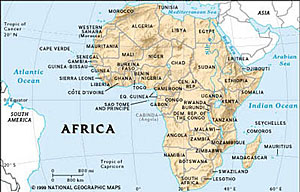
Montevideo, the capital of Uruguay, was founded by the Spanish in a process that was begun in 1724 and completed in 1730. African slaves were first introduced to the city in 1750. The roots of this population were not homogeneous, but rather a multi-ethnic swath of Africa that was culturally quite varied. 71% were sourced from the Bantu area, from Eastern and Equatorial Africa, while the rest came from non-Bantu Western Africa: Guinea, Senegal, Gambia, Sierra Leone, and the Gold Coast (what is today Ghana).

Map of Africa
The Bantu area is an enormous cultural region of Africa with an extremely complex mosaic of ethnicities, consisting of over 450 groups with a linguistic heritage that overwhelms man's migratory limits: more than 20 linguistic groups and 70 dialects.
* these indices were compiled from documents of the Montevideo census of 1812, part of the nation's general archives.
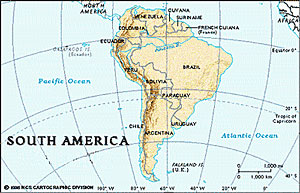
Map of South America
It is believed that no less than ten million "ebony pieces" disembarked on the coasts of North and South America. This implies a bleeding of sixty million souls, if we consider that only one of every six victims of this human traffic ever made it alive to the harbors where they were to be auctioned. To understand what this meant, in demographic terms, it is sufficient to consider that at the beginning of the 19th Century, Buenos Aires had a population of merely 50 thousand.
* from the prologue, written by Adolfo Colombres, to the book "El Candombe" by Ruben Carambula

Biafra was dead, nobody wanted to get there
Who could care, anyhow, about some dying blacks?
Biafra, you're deserted and your drums are no longer around
While they could, your people sang:
Ne-ia ne-ia cumaia-nagata
Ne-ia ne-ia cumaia-nagata.
* from the candombe "Biafra" by Ruben Rada, in the introduction to the book "Los Tambores del Candombe" by Luis Ferreira
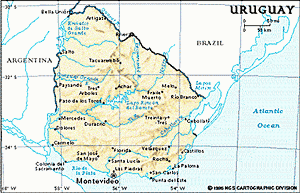
Map of Uruguay
Candombe is what survives of the ancestral heritage of Bantu roots, brought by the blacks arriving at the Río de la Plata. The term is generic for all black dances: synonymous with and evoking the rituals of that race. Its musical spirit sums up the sorrows of the unfortunate slaves, who were hastily transplanted to South America to be sold and subjected to brutal work. These were pained souls, harboring an inconsolable nostalgia for their homeland. During colonial times, the newly arrived Africans called their drums tangó, and used this term to refer to the place where they gathered to perform their candombe dances; by extension, the dances themselves were also called tangós. With the word tangó, they defined the place, the instrument, and the dance of the blacks.
Old Candombe Photo
At the dawn of the 19th Century, Montevideo's Establishment was deeply troubled by the existence of the candombes, which they indistinctly called tambo or tangó. They banned them and harshly punished their participants, considering the dances a threat to public morals. In 1808 the citizens of Montevideo requested that the governor repress these dances even more severely and "prohibit the tangós of the blacks."
* from the book "Candombe" by Ruben Carambula

In Africa, Tambor and the person playing it are defined by the same word, Tambor.


The African poet Amos Totuola writes:

When the Tambor
Began to play the Tambor
Those who had been
Dead for years
Came forth to witness
How the Tambor played the Tambor.
"Kalunga kalungangue O-je o-je Imbambue."

It was the voice of the old "tatas" of candombe from the middle of the last Century, bellowing in the halls of black clandestine gatherings, sons and grandsons of those brought over in the holds of the slave ships. From 1751 to 1810, Montevideo received large contingents of Africans aboard vessels flying English and Spanish flags. While their culture was quickly repressed by the Spanish, their need for expression, their liberation, was maintained through their Tambor.

The Tambor of candombe is the presence of ancestral Africa in Uruguay.

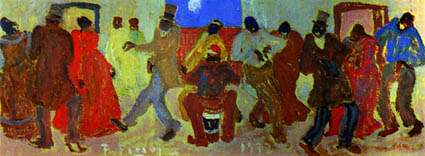
Figari Painting
Candombe (24cm x 64cm) painting by Pedro Figari
Painted in the year 1932 ( he was 71 years of age at that time), one should consider that the image above was painted from Figari's memories of his childhood, which reflects the mid-nineteenth century candombe-gatherings, as described.


The houses where the slaves gathered, with their masters' permission, were off-limits to the general public in Montevideo of old. These were called tangós, and within their walls the slaves celebrated their festivities and ceremonies to the sound of the Tambor.

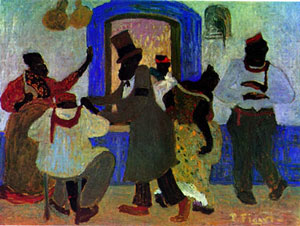
Figari Painting

From this period of original celebrations in Uruguay, only the musical gathering is retained today, and find their principal manifestation in the "llamadas" of Barrio Sur and Palermo. In the sounds of the piano, the chico and the repique, the slaves have been able to preserve their ancestral memory.
* excerpts of the paper presented in August 1994, in Salvador, Bahia, at the Second International Congress of Afro-American Cultures by Aglimira "La Negra" Villalba

Impassioned by the rhythm, with a fleeting and naive joy, the dance is the reward for their tasks in the stables, for the jobs as porters that leave their agile bodies bent.
* written by by Samuel Oliver, excerpt from the book 'Figari', 1984, by Samuel Oliver from the collection "Artistas de Americas".

On the 28th of October, 1846, the president of the Republic, Joaquin Suarez, abolished slavery in Uruguay, in a process that began in 1825.
* information supplied by Virginia Martinez

Uruguay abolished slavery, documents described African dance rituals in Montevideo and the countryside known as tangós, with the accent on the second syllable. The word referred variously to the drums, the dances and the places where the religious rituals were held. Therein lies an intriguing musicological tale about the obscure origins of the tango, one of the best-known Latin American musical genres.


El Tango by Pedro Figari 35x50cm

The tango developed simultaneously in Montevideo and Buenos Aires. Although typically regarded as the creation of Italian and Spanish immigrants, the tango's music and the dance movements associated with it were deeply influenced by African dance and music, according to experts.

Argentina's black population all but disappeared, decimated in the 1800s by yellow fever, intermarriage and massive military recruitment of blacks, who then died in wars. In Uruguay, people of African descent accounted for about half the population two centuries ago; they now number about 189,000 in a nation of 3.2 million.
* excerpts from L.A. Times article by Sebastian Rotella

Uruguayan Flag Oriental Republic of Uruguay
Short Form: Uruguay
Capital: Montevideo
Language: Spanish
After independence was declared in 1825, civil wars disrupted the republic for almost 75 years. Military rule muzzled Uruguay from 1973 until democracy was restored in 1985, when many refugees came home. About 90 percent of Uruguayans - most of Spanish or Italian descent - live in cities, with Montevideo home to two-fifths. Education is compulsory and free, one of Latin America's most literate.
* Text source: National Geographic Atlas of the World Revised Sixth Edition, 1995

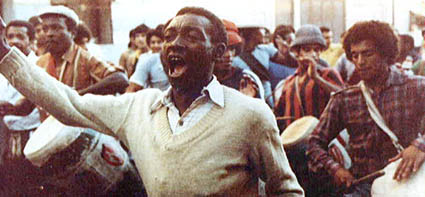
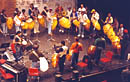
Montevideo, Uruguay-On Sunday nights, the drummers of Barrio Sur assemble by firelight at an intersection in the historic black neighborhood in a tranquil corner of South America. Flames dance in a gutter bonfire lighted to tone the hides of the drums. Rows of drummers pound down the street in a blur of muscle, sweat and sound, filling the night with an African-derived rhythm known as candombe.
Photo of Candombe in the Street
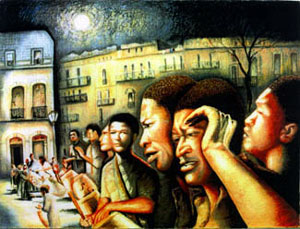
Luna, Barrio y Tamboril by Fernando Gomez Germano
The street-corner ritual is part of a neglected chapter of the African diaspora. The drums tell a story of the profound impact that African culture has had in Uruguay and elsewhere in Latin America. In fact, Afro-Uruguayans celebrate an often-ignored piece of history
* excerpts from L.A. Times article by Sebastian Rotella
Nostalgias del Candombe by P. Figari
Nostalgias del Candombe by Pedro Figari 60x80cm
The Creole, who once formed the whole nation, now prefers to be one of many. So that there may be greater glories in the land, glories must be forgotten. The memory of them is almost an act of remorse, the reproach of things abandoned without the intercession of a goodbye. It is a memory which is rescued, as the Creole destiny requires, for the gallantry and perfection of its sacrifice.
* written by Jorge Luis Borges, 'Figari', published in Buenos Aires Editorial, 1930, translated by David Balderstom, excerpt from the book 'Figari', 1984, by Samuel Oliver from the collection "Artistas de Americas".

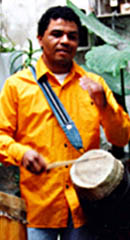
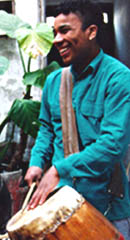
The candombe rhythm is created by the use of three drums (tambores), tambor piano, tambor chico and tambor repique. When these three drums heat up, it's like nothing you've ever heard before. On the following page you will be able to hear the distinct sound of each of these three tambores

Drumbs of Candombe

Tambor Piano
Tambor Piano

Tambor Chico
Tambor Chico

Tambor Repique
Tambor Repique
The piano is the largest in size, and lowest in pitch of the three drums, holding the rhythmic base of candombe. Its rhythmic function is similar to the upright or electric bass. Its drumhead measures approximately sixteen inches in diameter.
The chico (small) name given because of its size and thinner drumhead, the highest in pitch of the three drums, and the rhythmic pendulum of the cuerda. Its drumhead measures approximately eight-and-one-half inches in diameter.
The repique's (ricochet) name tells us this drum embellishes candombe's rhythm with improvised phrases. Its drumhead measures approximately twelve inches in diameter.
Together these three tambores create candombe.
Together these three drums are called a Cuerda
Cuerda

Candombe Terms
Ansina: a social group in Montevideo, and one of the city's two uncontested candombe families. In the 1800s, when Uruguay joined other colonies in fighting for independence from Spain, Uruguayan national hero Jose Artigas led an elite division of troops against the colonists. One of his top advisors was Joaquin Lezina, known as Ansina, a freed slave who composed musical odes about his commander's exploits and is regarded by Afro-Uruguayans as an unheralded father of the nation. The heart of Montevideo's candombe community was once two tenements that are abandoned ruins today; Ansina (named after the historical figure) and Medio Mundo. The tenements were a center for candombe performances known as llamadas (drum calls), a direct offshoot of the slave dances.
Candombe: Afro-Uruguayan rhythmic and musical style, based on three tambores: piano, chico, and repique .
Chico (small): smallest and highest in pitch of the three tambores, its head measures 8.5 inches in diameter; the chico is the rhythmic pendulum of the cuerda.
Comparsa: a group that performs candombe during Montevidean carnival.
Cuareim: a social group in Montevideo, and one of the city's two uncontested candombe families.
Cuerda: family of three tambores (piano, chico, and repique); at a minimum, a cuerda consists of three people, each playing one of the three tambores.
Escobero: young man who leads the tambores down the streets, dancing with a headless broomstick twirling behind his back and up and down his arms; also called Escobillero.
Gramillero: knowledgeable grandfather wise in the ways of wild herbs and their healing properties; he is the true seed, exuding joy, experience,and pleasure contagious to all around him; king of the tambores, all-knowing sage full of memories and remembrances. El Gramillero embodiment of candombe.
Isla de Flores: the main street that joins Cuareim and Ansina, Montevideo's two main candombe social groups. For over a century, spontaneous cuerdas have paraded on this street, and continue to do so today. Also known by its second name, Carlos Gardel, after the greatest tango singer of all time.
Lubolo: a white performer who paints his face black to perform during Montevidean carnival.
Mama Vieja: the matron of candombe and the Gramillero's mate; dressed in her simple, handmade dress, she dances slowly and fans herself nervously while keeping the Gramillero dancing nearby.
Milongon: a slow candombe.
Morenos: pleasant term used to refer to black persons in Uruguay.
Piano: largest and lowest in pitch of the three tambores, its head measures 16 inches in diameter; responsible for the rhythmic base of candombe, its rhythmic function is similar to the upright or electric bass.
Repique (ricochet): its name tells us this tambor embellishes candombe's rhythm with improvised phrases; its head measures 12 inches in diameter.
Tambor: candombe drum ( tambor piano, tambor chico, tambor repique).

Candombe is for people of all ages. Uruguayan children begin to learn about candombe at a very early age.